By LaserSpecHub Engineering Team
Content reviewed and updated March 2026
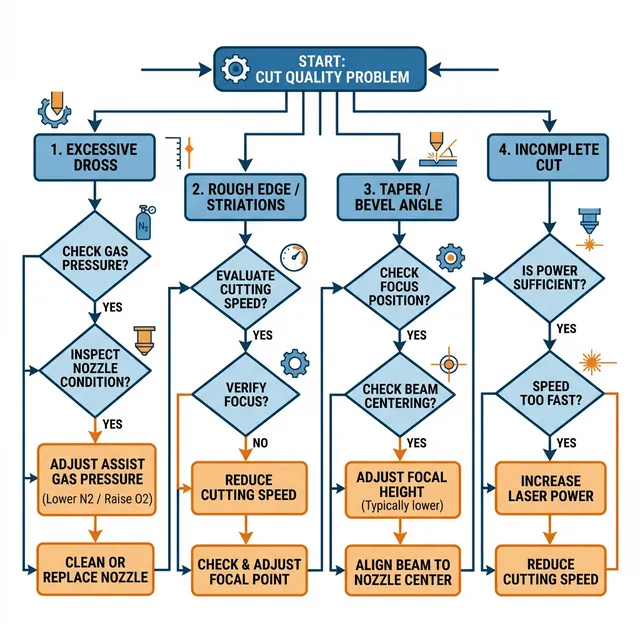
Organized troubleshooting solutions by category
Start here: These 3 issues account for 65% of all cutting quality problems
Focus position significantly affects cut quality. Adjust based on material thickness and desired edge characteristics.
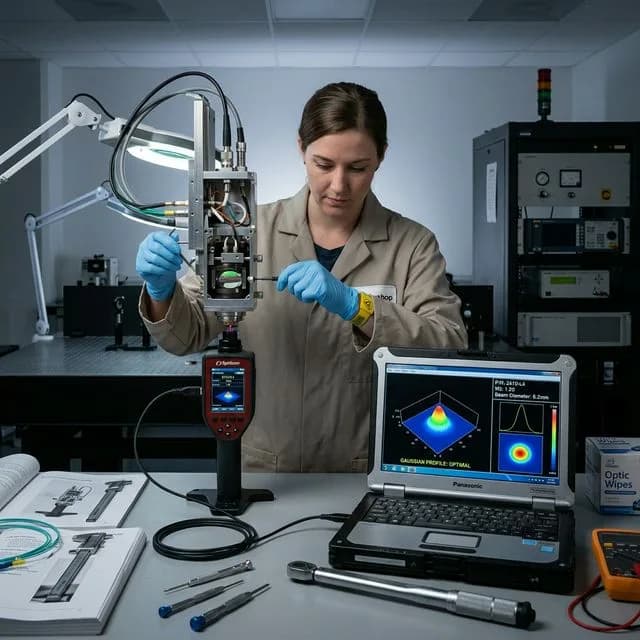
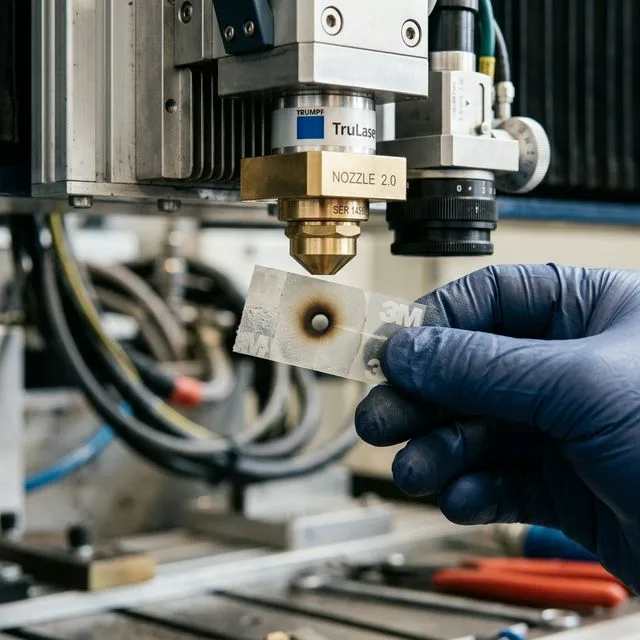
Proper beam centering in nozzle bore is critical for perpendicular cuts and consistent quality.
Gas system troubleshooting: Check cylinder level → Verify regulator setting → Inspect filter → Test valve operation → Measure cutting head pressure.
| Issue Type | CO2 Laser (10.6μm) | Fiber Laser (1.06μm) | Key Differences |
|---|---|---|---|
| Reflective Materials (Al, Cu, Brass) | Extremely difficult, high reflectivity (90-95%) can damage optics. Avoid or use special coatings. | Manageable with proper settings. Reflectivity 70-85%. Increase nitrogen pressure to 16-20 bar, reduce speed 30-40%. | Fiber lasers handle reflective metals far better due to wavelength absorption characteristics |
| Focus Sensitivity | Larger focal spot (0.15-0.3mm), more forgiving focus tolerance (±1-2mm). Longer Rayleigh length. | Smaller focal spot (0.05-0.15mm), critical focus positioning (±0.5mm). Shorter depth of focus. | Fiber lasers require more precise focus calibration and maintenance |
| Power Degradation Pattern | Gradual tube wear over 2,000-10,000 hours. Rechargeable tubes available. Monitor voltage increase as indicator. | Diode aging over 30,000-100,000 hours. Non-serviceable by user. Monitor total operating hours and power calibration. | Fiber lasers have 3-10x longer operational life but cannot be refurbished |
| Optics Contamination | ZnSe lenses and mirrors highly susceptible to moisture, spatter. Clean every 40-100 hours. Cost: $150-600/lens. | Quartz protective window primary concern. Clean every 100-300 hours. Fiber delivery path sealed. Cost: $50-200/window. | Fiber lasers have simpler optics maintenance with sealed beam delivery |
| Beam Alignment Issues | Multiple mirror alignment critical. Thermal drift affects alignment. Quarterly calibration recommended. Complex adjustment procedure. | Fiber cable delivery eliminates most alignment issues. Collimator and focus lens only. Stable over temperature. Annual check sufficient. | Fiber lasers drastically reduce beam alignment troubleshooting frequency |
| Thin Material (<1mm) Cutting | Excellent for thin materials. Lower power density suitable for delicate work. Minimal heat-affected zone achievable. | Excessive power density can cause breakthrough damage. Use defocused beam (+2 to +4mm) or reduce power to 20-40%. | CO2 lasers naturally better suited for very thin material processing |
| Thick Material (>15mm) Cutting | Limited capability above 20-25mm even at high power (4-6kW). Oxygen assist essential for carbon steel. | Superior performance up to 30-40mm with 6-12kW systems. Better power density penetration. Nitrogen or oxygen assist. | Fiber lasers excel at thick plate cutting due to higher power density |
| Electrical Efficiency | 8-15% wall-plug efficiency. Higher operating costs. Significant cooling requirements (chiller capacity 2-3x laser power). | 25-40% wall-plug efficiency. Lower operating costs. Reduced cooling needs (chiller capacity 1-1.5x laser power). | Fiber lasers offer 60-70% reduction in energy consumption per watt of laser output |
| Startup/Warmup Time | 15-30 minute warmup required for thermal stability. Power instability if started cold. | Instant-on capability. Full power available within 1-2 minutes. No thermal warmup needed. | Fiber lasers eliminate warmup-related troubleshooting issues |
| Non-Metal Materials | Excellent for wood, acrylic, leather, fabric, paper. Primary choice for organic materials and plastics. | Limited effectiveness on non-metals due to poor absorption at 1.06μm wavelength. Not recommended for organic materials. | CO2 lasers are the standard for non-metal material processing |
Effective troubleshooting follows the OBSERVE-ISOLATE-TEST-VERIFY approach. First, document the exact symptom with quantitative data (e.g., "burr height 0.5mm on bottom edge" vs. "bad cut quality"). Second, change one variable at a time—adjusting focus, pressure, and speed simultaneously makes it impossible to identify root cause. Third, test with controlled samples using consistent material batches and positions. Finally, verify the fix by running production parts, not just test coupons.
Common Diagnostic Pitfalls: Assuming the most complex cause first (often it's a dirty lens or loose nozzle), failing to check consumables before adjusting parameters, and making multiple changes without documenting which one resolved the issue. Professional laser operators maintain detailed fault logs tracking symptoms, conditions, actions taken, and outcomes—this historical data accelerates future troubleshooting by 40-60%.
| Symptom | Primary Check | Secondary Check | Reference |
|---|---|---|---|
| Burrs on edge | Focus position | Gas pressure | Focus Guide |
| Incomplete penetration | Laser power | Cutting speed | Parameters |
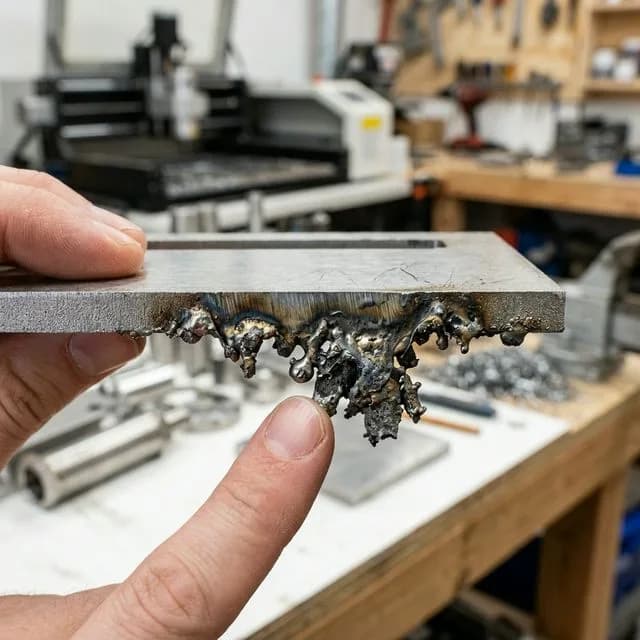
| Excessive dross | Gas pressure | Nozzle condition | Gas Chart |
| Angled cut surface | Nozzle alignment | Beam centering | Nozzle Alignment |
| Inconsistent quality | Optics cleanliness | Material variation | Optics Guide |
| Corner overburn | Power compensation | Speed settings | Process Guide |
Symptom: Yellow/blue discoloration on nitrogen cutting. Cause: Insufficient nitrogen pressure (<12 bar) or purity (<99.5%). Solution: Increase pressure to 14-18 bar, verify nitrogen purity with oxygen analyzer (target: <100ppm O₂). Refer to Assist Gas Guide for gas purity specifications.
Symptom: Heavy dross on air cutting. Cause: Excessive oxidation in melt pool. Solution: Increase speed by 10-15% to reduce heat input, use positive focus (+0.5 to +1.0mm), ensure sharp focus spot for better energy concentration.
Symptom: Inconsistent cutting or frequent breakthrough failures. Cause: High reflectivity (90%+) causes power instability. Solution: Use fiber lasers with aluminum-optimized wavelength control, increase nitrogen pressure to 16-20 bar for strong melt ejection, reduce speed by 30-40% vs. equivalent steel thickness. See aluminum cutting parameters.
Symptom: Severe edge oxidation. Cause: Aluminum's high thermal conductivity spreads heat rapidly. Solution: Mandatory high-purity nitrogen (99.9%+), increase gas flow rate by 20-30% compared to steel cutting.
Symptom: Taper or non-perpendicular edges on 15mm+ material. Cause: Insufficient depth of focus or power density gradient through thickness. Solution: Use negative focus (-2 to -4mm) to position focal waist mid-thickness, reduce speed to allow adequate melt time. Consult Focus Position Guide for thick plate strategies.
Symptom: Excessive slag or rough bottom edge. Cause: Oxygen pressure too high or cutting speed too slow causing over-oxidation. Solution: Reduce oxygen pressure to 0.3-0.6 bar for thin materials (1-6mm), increase speed by 10-15%, ensure nozzle standoff at 0.7-1.0mm. Reference Speed Chart.
Symptom: Inconsistent penetration or reflective damage to optics. Cause: Brass has high reflectivity (85-90% for CO2, 70-80% for fiber) and high thermal conductivity causing rapid heat dissipation. Zinc vaporization at 907°C can create fumes.
Solution: Fiber lasers strongly preferred over CO2. Use high-purity nitrogen (99.9%+) at 16-20 bar pressure. Reduce speed by 25-35% compared to steel of equivalent thickness. Use negative focus (-1 to -2mm) for materials >3mm. Ensure excellent fume extraction due to zinc oxide vapor. Monitor protective window for contamination—brass produces more optical fouling than steel.
Symptom: Extremely difficult to cut, frequent failures, or laser damage. Cause: Copper has the highest reflectivity (95%+ for CO2, 90-95% for fiber at room temperature) and thermal conductivity (400 W/m·K) of common metals. Heat dissipates faster than laser can melt material.
Solution for Fiber Lasers: Only fiber lasers can reliably cut copper. Use maximum available power (minimum 3kW for thin sheets, 6-12kW for >3mm). Preheat material to 200-300°C if possible to reduce reflectivity. Nitrogen pressure 18-22 bar. Extremely slow speeds: 50-70% of steel cutting speed. Use burst/pulsed mode if available for piercing. Monitor cutting head for reflected energy damage.
CO2 Laser Warning: Pure copper cutting with CO2 lasers is generally not feasible and dangerous to optics. Reflectivity can cause catastrophic damage. Only copper alloys with <80% copper content (like brass or bronze) are suitable for CO2 processing, and even then with extreme caution.
Symptom: Excessive oxidation, discoloration, or embrittlement of cut edges. Cause: Titanium is highly reactive with oxygen at elevated temperatures, forming brittle titanium oxide layer. However, material cuts relatively easily due to low thermal conductivity and high laser absorption.
Solution: Mandatory use of inert gas—argon preferred over nitrogen for critical applications (aerospace, medical). Argon provides better shielding against oxidation. Pressure: 12-16 bar. If using nitrogen (cost consideration), increase purity to 99.99%+ and pressure to 16-20 bar. Use positive focus (+0.5 to +1mm) for clean top edge. Speed comparable to stainless steel but power may need 10-15% increase.
Quality Inspection: Titanium cut edges should be silver-gray. Blue, purple, or gold discoloration indicates oxygen contamination and potential embrittlement. For critical applications, perform dye penetrant testing or metallurgical inspection of heat-affected zone. See Edge Quality Standards for titanium-specific criteria.
Early Warning Signs: Gradual quality degradation often precedes catastrophic failures. Monitor trending metrics: average cutting speed reduction (>5% decline over 2 weeks may indicate power loss or optics degradation), increasing pierce time (lens contamination), rising dross formation (nozzle wear), or beam alignment drift requiring frequent recalibration. Address these indicators proactively before they cause production downtime.
Consumables Life Tracking: Implement hour meters on critical components: protective windows (200-400 hours depending on material), nozzles (80-200 hours), focus lenses (1,000-2,000 hours). Replace on schedule rather than waiting for failure—a $120 protective window replaced preventively costs far less than emergency downtime and potential cutting head damage ($5,000-12,000). See Nozzle Life Management.
Data-Driven Optimization: Modern CNC systems log every cut with metadata (material, thickness, power, speed, gas pressure). Analyze this data quarterly to identify parameter drift, operator inconsistencies, or material batch variations. High-performing fabrication shops reduce troubleshooting time by 50-70% through systematic data analysis compared to reactive troubleshooting. Explore Process Optimization strategies.
Optimal Range: 18-25°C (64-77°F). Outside this range, beam alignment drift can occur due to thermal expansion of machine frame and optical mounts. Every 10°C temperature change can shift beam position by 0.1-0.3mm, affecting cut quality.
Troubleshooting: If quality issues appear seasonally or during temperature swings, check beam alignment and recalibrate focus. Install HVAC or thermal barriers to maintain stable workshop temperature. Monitor chiller water temperature stability (±1°C required).
Optimal Range: 40-60% relative humidity (RH). High humidity (>70% RH) causes condensation on optics, especially when equipment is cooler than ambient. Low humidity (<30% RH) increases static electricity, attracting dust to optics.
Troubleshooting: Moisture spots on lenses indicate condensation issues—install dehumidifier or increase workshop temperature. Rapid optics contamination suggests static buildup—use anti-static spray on work surfaces and increase humidity. Store optics in sealed containers with desiccant packs.
Sensitivity: Laser cutting requires vibration isolation below 0.05g (0.5 m/s²). External vibration from nearby machinery, forklifts, or building resonance causes inconsistent cut quality, especially visible in fine details and corners.
Troubleshooting: Perform cut quality test when suspected sources are off vs. on. Install vibration isolation pads under machine feet (typical isolation: 90% reduction at 5-50 Hz). Separate laser from stamping presses, grinders, or heavy traffic areas. Use smartphone accelerometer apps to measure baseline vibration.
Requirements: Proper fume extraction (minimum 1,000-2,000 CFM for typical cutting bed) prevents smoke recirculation that contaminates optics. Inadequate extraction also creates hazardous work environment and can trigger fire alarms.
Troubleshooting: Visible smoke in work area or rapid protective window contamination indicates insufficient extraction. Check filter loading (differential pressure gauge should read <2 inches H₂O). Verify exhaust fan operation and duct integrity. Clean or replace filters per manufacturer schedule (typically every 2-6 months depending on utilization).
| Component | Inspection Frequency | Replacement Interval | Warning Signs |
|---|---|---|---|
| Protective Window | Daily (visual), Weekly (clean) | 200-400 hours or when contamination cannot be removed | Yellowing, pitting, stubborn stains, reduced cutting performance |
| Focusing Lens | Weekly (inspect), Bi-weekly (clean) | 1,000-2,000 hours or when damaged | Visible coating damage, thermal cracks, power loss, beam quality degradation |
| Nozzle | Daily (check centering/damage) | 80-200 hours (single-layer), 500-1,000 hours (ceramic) | Oval orifice, spatter buildup, inconsistent gas flow, burrs increase |
| Mirrors (CO2 only) | Monthly (inspect), Quarterly (clean) | 2-5 years or when coating damaged | Power loss, beam alignment drift, visible coating deterioration |
| Collimator (Fiber only) | Quarterly (inspect) | 5,000-10,000 hours or when damaged | Beam quality issues, focal spot enlargement, power instability |
| Chiller Water/Filter | Weekly (level check), Monthly (quality check) | Water: 6-12 months, Filter: 3-6 months | Discolored water, reduced flow rate, temperature instability, algae growth |
| Drive Belts | Monthly (tension check) | 2,000-4,000 hours or when worn | Excessive deflection (>5mm), fraying, position loss, belt dust accumulation |
| Linear Rails/Guides | Monthly (lubrication), Quarterly (wear check) | 5-10 years depending on usage | Increased noise, rough motion, visible wear tracks, positioning errors |
| Assist Gas Filters | Monthly (inspect), Clean as needed | 6-12 months or when pressure drop >0.5 bar | Reduced pressure downstream, moisture in gas line, cutting quality decline |
| Exhaust Filters | Monthly (pressure check) | 2-6 months depending on material types | Reduced suction, visible smoke in workspace, pressure >2 inches H₂O |
| Capacitive Sensor | Weekly (clean), Monthly (calibrate) | 3-5 years or when unreliable | Inconsistent sensing, false triggers, calibration drift, spatter buildup |
| Beam Alignment (CO2) | Quarterly (verify), Semi-annually (full calibration) | N/A (adjustment only) | Off-center burn patterns, position-dependent quality variation |
Learn proper focus calibration techniques and troubleshoot focus-related issues
Choose correct nozzles, check alignment, and optimize standoff distance
Reference cutting parameters for different materials and thicknesses
Optimize gas type, pressure, and flow rates for your application
Advanced strategies for maximizing cutting efficiency and quality
Find optimal cutting speeds for various materials and power levels
Understand quality classifications and inspection criteria
Essential safety protocols and emergency procedures
Calculate required power for your cutting application
Estimate kerf width and compensation values
Determine gas consumption and monthly costs
Disclaimer: This troubleshooting guide provides general diagnostic procedures based on industry best practices and manufacturer documentation. Actual troubleshooting procedures may vary by equipment model, laser type, control system, and specific operating conditions. Always consult your equipment manufacturer's service manual for model-specific procedures and safety requirements. For complex issues or when in doubt, contact qualified service technicians.
Pro Tip: Establish a "first-piece inspection and anomaly logging" system for faster problem reproduction and identification. Maintain detailed fault logs tracking symptoms, environmental conditions, actions taken, and outcomes. Systematic documentation can improve troubleshooting efficiency by 50-70% and build valuable institutional knowledge.
Last Updated: January 15, 2026 | Page Version: 3.0 (Enhanced with Engraving, Emergency Procedures, Laser Type Comparison)
Questions or suggestions? Contact Us