By LaserSpecHub Engineering Team
Content reviewed and updated March 2026
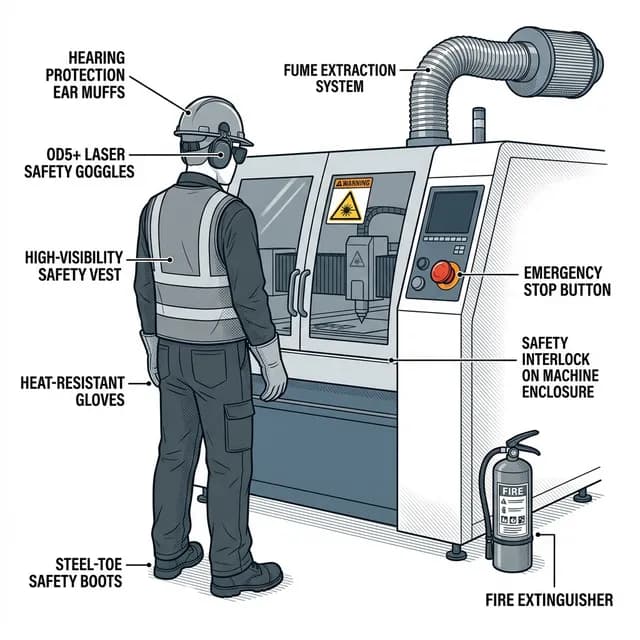
Industrial laser cutters (Class 4 systems) present serious hazards including eye damage, skin burns, fire risk, and toxic fume exposure. This comprehensive safety guide provides OSHA-compliant procedures, training programs, emergency protocols, and regulatory compliance frameworks to protect personnel and facilities.
⚠️ Critical Safety Warning: Class 4 lasers (industrial cutting lasers 1kW+) can cause permanent eye damage in 0.25 seconds, ignite clothing/materials instantly, and produce toxic fumes. Direct or reflected beam exposure can cause irreversible injury. Comprehensive safety training, engineering controls, and PPE are mandatory—not optional. Annual incident rate: 2-5 injuries per 1,000 operators without proper safety protocols. Compliance saves lives and prevents $50,000-500,000 liability costs per incident.
Industrial laser cutters are classified as Class 4 lasers—the highest hazard level per IEC 60825-1 and ANSI Z136.1. Class 4 lasers exceed 0.5W output power and pose severe eye/skin hazards from direct or diffusely reflected beams. Understanding hazard levels informs appropriate safety measures.
Direct beam exposure causes corneal burns, retinal damage, or total blindness in 0.1-1.0 seconds. Diffuse reflections from shiny surfaces (aluminum, stainless) can injure at 1-3 meters distance. No warning, no recovery—damage is instant and irreversible.
1-12kW beam cuts through clothing and flesh instantly. Contact causes 3rd degree burns penetrating to bone. Reflected beams can ignite synthetic clothing (nylon, polyester melts at 250-280°C). 6kW laser = 6,000 watts focused to 0.2mm spot = 95 million W/m² power density.
Beam ignites paper (233°C), wood (300°C), plastics (300-500°C), and fabrics instantly. Cutting metal produces sparks igniting nearby combustibles. Oxygen-assisted cutting exacerbates fire risk. Annual fire incidents: 5-10 per 10,000 laser installations, $25,000-250,000 average damage.
Metal vaporization creates metal oxide particulates (Fe₂O₃, Cr₂O₃ from stainless = carcinogenic). Plastic cutting releases HCl, phosgene, dioxins. Inadequate ventilation causes acute respiratory distress, long-term lung disease, heavy metal poisoning. OSHA PEL: Cr(VI) 5μg/m³ (cutting stainless generates 50-500μg/m³ without extraction).
Fiber lasers: 200-480V 3-phase, 30-150A circuits. Capacitor banks store lethal energy (remain charged 30+ minutes after power-off). Annual electrocution incidents: 1-2 per 100,000 installations, 30% fatality rate. Lockout/tagout mandatory.
CNC axes accelerate to 2-3G, moving at 80-120 m/min (4,800 m/hour). Collision force sufficient to crush fingers, hands. Light curtains and interlocks prevent entry during operation. Crush injuries: 10-15 per 100,000 operator-years.
Nitrogen/oxygen assist gas at 10-25 bar (145-360 PSI). Hose failures create whip hazards (150 m/s tip speed = deadly projectile). Oxygen leaks accelerate fires. Confined space asphyxiation risk with nitrogen displacement. Annual gas-related incidents: 2-3 per 10,000 installations.
Cutting operations: 75-95 dB(A). Assist gas flow, extraction fans, material impacts generate sustained noise. OSHA action level 85 dB(A) TWA requires hearing conservation program. Long-term exposure causes permanent hearing loss (20-30% of operators show measurable hearing degradation after 5-10 years without protection).
PPE is the last line of defense after engineering controls (enclosures, interlocks) and administrative controls (training, procedures). ANSI Z136.1 mandates specific PPE based on laser wavelength, power, and exposure scenarios.
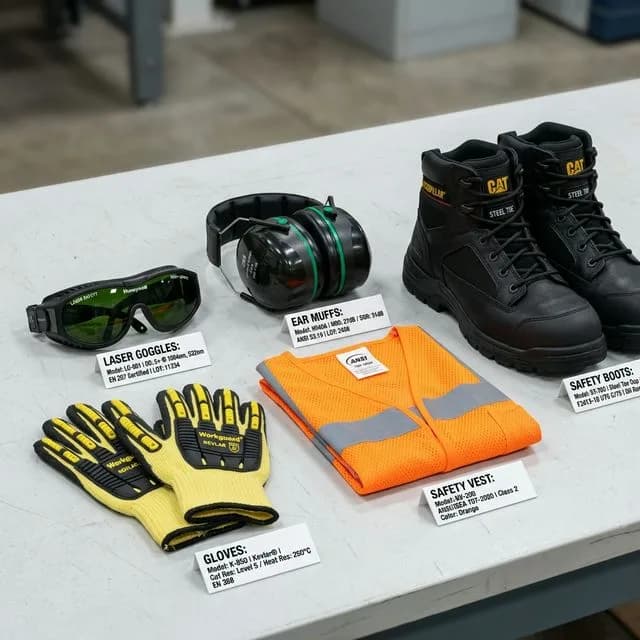
| PPE Item | Specification | Purpose & Standards | Cost & Replacement |
|---|---|---|---|
| Laser Safety Eyewear | OD 5+ at 1064nm (fiber laser) OD 7+ at 10600nm (CO2 laser) Side shields, impact rated | Blocks direct/reflected beam preventing retinal damage. ANSI Z136.1 requires OD sufficient for MPE (Maximum Permissible Exposure). Visible Light Transmission (VLT) 20-40% for usability. | $150-400/pair Replace: 2-3 years or if scratched/damaged |
| Respiratory Protection | N95/FFP2 minimum (metal fumes) P100/FFP3 (toxic materials) Half-face respirator (high exposure) | Filters metal oxide particulates, organic vapors. NIOSH approval required. Fit testing mandatory (OSHA 1910.134). N95 blocks 95% of 0.3μm particles; P100 blocks 99.97%. | N95: $1-3 (disposable) Half-face: $150-300 Replace: Per manufacturer schedule |
| Protective Gloves | Cut-resistant (ANSI Level 3+) Heat-resistant (250°C+) Non-reflective material | Protects from sharp edges, hot material, minor burns. Kevlar/Dyneema blend provides cut + heat resistance. Leather alternative for heavy work. Never use near rotating machinery (entanglement risk). | $15-40/pair Replace: 3-6 months or when damaged |
| Flame-Resistant Clothing | Cotton (natural fiber, non-melting) FR-treated workwear (NFPA 2112) Long sleeves, no exposed skin | Prevents ignition from sparks/hot material. Synthetic fabrics (polyester, nylon) melt onto skin causing severe burns. FR clothing self-extinguishes upon removal from heat source. Dark colors reduce laser reflections. | Cotton workwear: $30-60/set FR-rated: $80-150/set Replace: Annually or per laundry cycle limit |
| Safety Footwear | Steel/composite toe (ASTM F2413) Electrical hazard rated Non-slip sole | Protects from dropped materials, crush injuries, electrical shock. EH rating: withstands 18,000V at 60Hz in dry conditions. Metatarsal guards for heavy material handling. | $80-180/pair Replace: Annually or when sole worn |
| Hearing Protection | Foam earplugs (NRR 29-33 dB) Earmuffs (NRR 25-31 dB) Double protection (85+ dB environments) | Reduces noise exposure below OSHA PEL (90 dB TWA) and action level (85 dB). NRR (Noise Reduction Rating) de-rated per OSHA: (NRR-7)×0.5 = actual protection. 85 dB + NRR 29 earplugs = 74 dB effective. | Earplugs: $0.20-1/pair (disposable) Earmuffs: $15-50 Replace: Earplugs daily; earmuffs 1-2 years |
💡 PPE Cost vs Incident Cost: Complete PPE setup costs $400-700 per operator. Average laser injury medical costs: $25,000-150,000 (eye damage requiring surgery). OSHA citation for inadequate PPE: $7,000-14,000 per violation. Employer liability for preventable injury: $250,000-2,000,000 (lawsuit + settlement). PPE investment recovers itself preventing single incident.
OSHA General Duty Clause (Section 5(a)(1)) and ANSI Z136.1 mandate employer-provided laser safety training. Untrained operators account for 70-80% of laser incidents. Comprehensive training reduces incident rates by 85-95%. Below is a complete training curriculum framework.
OSHA and ANSI Z136.1 require annual retraining to reinforce safety knowledge, address procedural changes, and review incident trends.
Operators failing refresher must complete initial training before resuming independent operation. Training records retained 3+ years for OSHA inspection.
Maintain detailed training records per OSHA recordkeeping requirements:
Digital training management systems ($500-2,000/year) automate tracking, send expiration alerts, and generate OSHA-ready reports. Manual systems using spreadsheets acceptable but prone to oversight.
💡 Training ROI: Initial + annual training costs $500-1,200 per operator. Untrained operator incident average cost: $50,000-300,000 (injury, lost time, OSHA fines, legal). Single prevented incident justifies 5-10 years of comprehensive training program. Insurance premiums reduce 10-30% with documented training program. OSHA citations for inadequate training: $14,000-140,000 (serious to willful violations).
Despite preventive measures, emergencies occur. Rapid, correct response minimizes injury severity, prevents escalation, and limits liability. All operators must know emergency procedures by memory—hesitation costs lives.
Post-Incident: Do not restart equipment. Facility inspection by fire marshal + equipment inspection by technician mandatory before resuming operations. Document incident per OSHA 300 Log requirements.
Laser eye injuries are ophthalmic emergencies. Transport to hospital or ophthalmologist immediately. Inform medical staff: laser type (fiber/CO2), wavelength (1064nm/10600nm), power level, exposure duration (if known). Time is critical—retinal damage progresses rapidly without treatment.
Post-Incident: Full investigation mandatory. Identify root cause (bypassed interlock, defective eyewear, procedural violation). Implement corrective actions, retrain all operators, update procedures. Report to OSHA within 24 hours if hospitalization required.
Even if victim appears uninjured, electrical shock can cause cardiac arrhythmias hours later. Transport to ER for EKG monitoring. Symptoms requiring immediate medical attention: chest pain, irregular heartbeat, burns at entry/exit points, confusion, seizures, loss of consciousness.
OSHA 1910.147 mandates lockout/tagout for all maintenance/service work. De-energize equipment, lock disconnect in OFF position, tag with name/date, test for zero energy using multimeter. Capacitors remain charged 30+ minutes—wait or manually discharge through rated resistor. Authorized electricians only for high-voltage work (≥600V).
Verify fume extraction operational before cutting (350-1,500 CFM per machine). Check extraction filters monthly, replace at 80% capacity. Respirator mandatory if ventilation inadequate. Air quality monitoring (particulate + gas sensors) recommended for high-volume operations. OSHA PEL exceedance triggers enhanced controls.
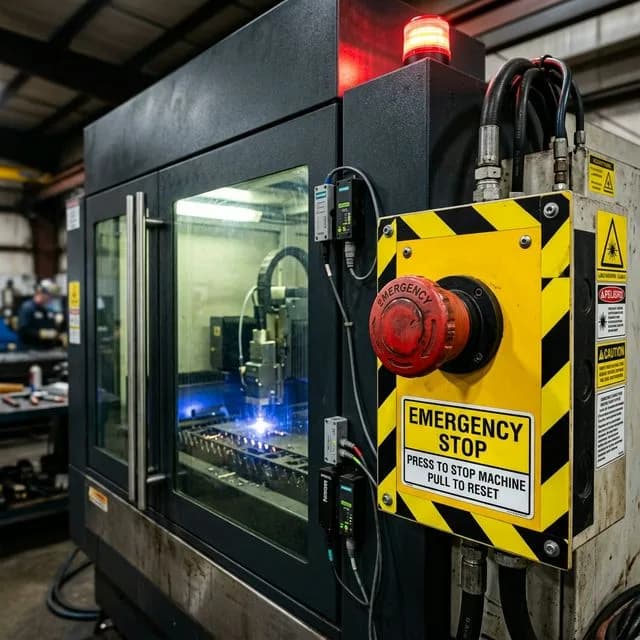
OSHA General Duty Clause and ANSI Z136.1 require documented pre-operation equipment inspections to verify all safety systems function properly before laser operation. A systematic daily inspection prevents equipment failures, identifies hazards before incidents occur, and provides legal documentation of due diligence. Operators must complete and sign inspection checklist daily—never skip or rush this critical safety procedure.
| Inspection Item | Check Method | Pass Criteria | Fail Action |
|---|---|---|---|
| 1. Laser Safety Eyewear | Visual inspection of all eyewear at workstation | Clean lenses, no scratches/cracks, correct OD rating label visible, side shields intact | CRITICAL: Replace damaged eyewear immediately. Do not operate without proper eyewear. |
| 2. Emergency Stop Buttons | Press each E-stop, verify laser disables, release and reset | Laser immediately disables, axes brake, audible/visual indication, reset requires manual action | CRITICAL: Tag out equipment. Contact maintenance immediately. Do not operate. |
| 3. Door Interlock System | Open each access door during laser-armed mode (low power test) | Laser beam shutter closes immediately, control displays interlock fault message | CRITICAL: Tag out equipment. Bypassing interlocks is illegal and deadly. Contact maintenance. |
| 4. Beam Shutter Operation | Cycle beam shutter open/closed 3 times, observe indicator lights | Shutter responds within 0.5 seconds, indicator matches position, no abnormal sounds | CRITICAL: Tag out equipment. Shutter failure = uncontrolled beam exposure risk. |
| 5. Fume Extraction System | Start extraction, verify airflow at nozzle/workpiece with smoke pencil or tissue | Strong airflow (350-1,500 CFM per spec), no unusual noise, pressure gauge in green zone | CRITICAL: Do not cut without extraction. Toxic fume exposure = health hazard. Contact maintenance. |
| 6. Protective Lens Cleanliness | Remove nozzle assembly, inspect protective lens with flashlight | Lens clear, no contamination/pitting/cracks, securely mounted with retaining ring | Clean with optical wipes + isopropyl alcohol. Replace if damaged. Dirty lens = reduced power/fire risk. |
| 7. Nozzle Condition & Alignment | Visual inspection of nozzle orifice, centering relative to lens | No damage/spatter buildup, orifice centered, proper standoff height (0.5-2.0mm typical) | Replace nozzle if damaged. Misaligned nozzle causes poor cuts and potential lens damage. |
| 8. Assist Gas Pressure | Check pressure gauges for N₂ and O₂ (if used) | Supply pressure 12-20 bar (175-290 PSI), regulated pressure per material requirements (1-25 bar) | Refill cylinders if below minimum. Low pressure = poor cut quality, increased dross. |
| 9. Chiller Water Level & Temperature | Check sight glass or digital display on chiller unit | Water level 80-100% full, temperature 18-25°C (64-77°F), no low-water alarms | Top up with deionized/distilled water. Overheating damages laser source (repair cost $10,000-50,000). |
| 10. Cooling Water Conductivity | Use conductivity meter if available (fiber lasers) | Conductivity <10 μS/cm (fiber laser spec), clear appearance, no algae/contamination | Replace water if conductivity high. Contaminated water causes electrical shorts in laser module. |
| 11. Servo System Lubrication | Visual inspection of linear guides and rack/pinion, feel for roughness during manual jog | Light grease coating visible, smooth motion with no binding or noise | CRITICAL: Lubricate per maintenance schedule. Dry guides cause positioning errors and crashes. |
| 12. Worktable Positioning Accuracy | Home all axes, jog to known reference point, measure position or run test pattern | Position repeatable within ±0.1mm, no axis drift, homing completes without errors | Recalibrate axes or contact technician. Poor accuracy causes scrap parts. |
| 13. Warning Signs & Labels | Walk around equipment, verify all safety signs visible and legible | Class 4 laser warning signs at all access points, no faded/missing labels, emergency contacts posted | Replace missing/damaged signs. OSHA/FDA requirement—citations issued for non-compliance. |
| 14. Fire Extinguisher Accessibility | Verify fire extinguisher location, check pressure gauge and inspection tag | Extinguisher within 3 meters, pressure gauge in green zone, inspection current (within 1 year) | Contact facility maintenance to recharge/replace extinguisher. Do not operate without fire protection. |
| 15. Eye Wash Station Function | Activate eye wash station, verify both streams flow properly | Both streams flow at proper height (83-135cm / 33-53 inches), tepid water, activates in <1 second | Tag station out-of-service, contact maintenance immediately. Eye wash = critical emergency equipment. |
| 16. Electrical Ground Continuity | Use multimeter to test resistance from equipment frame to facility ground | Resistance <1Ω (ohm), ground connection tight and corrosion-free | CRITICAL: Tag out equipment. Ground fault = electrocution risk. Licensed electrician repair only. |
| 17. Control Panel Display | Power up control system, verify display shows no fault messages | Display clear and readable, no error codes, all indicator lights functional | Investigate any fault codes per operator manual. Do not clear faults without resolving root cause. |
| 18. Operator Logbook Documentation | Review previous shift logbook entries, document inspection results | No unresolved issues from previous shift, all inspection items checked and signed | Resolve any issues from previous shift before operating. Maintain continuous documentation chain. |
⏱️ Time Required: Complete checklist requires 10-15 minutes per day. Document all results in daily operation logbook with date, time, operator signature, and any corrective actions taken. Equipment must NOT operate if any critical items (1-6, 11, 16) fail inspection—tag out equipment and contact maintenance immediately. Skipping inspection to save time is a false economy: 15 minutes daily vs. $50,000-500,000 incident cost + potential injury. Insurance may deny claims if inspection documentation is incomplete.
Engineering controls are physical safety features designed into laser equipment to eliminate or reduce hazards at the source—the most effective safety approach per the hierarchy of controls. ANSI Z136.1 mandates specific engineering controls for Class 4 lasers including enclosures, interlocks, beam shutters, and extraction systems. These controls provide primary protection; PPE serves as backup only when engineering controls cannot fully eliminate exposure risk.
Class 4 industrial laser cutters must enclose the beam path and work area within protective housing that prevents direct or reflected beam exposure outside the enclosure. Enclosure converts Class 4 laser into Class 1 enclosed system during normal operation—no beam access, minimal hazard. Door opening triggers interlock, immediately disabling laser.
Observation windows use filter glass with OD 5+ at laser wavelength (1064nm fiber / 10600nm CO₂), visible light transmission 10-30% for clear viewing. Windows labeled with wavelength and OD rating, securely mounted in frames preventing bypass. Polycarbonate overlays protect filter glass from spatter/impact. Window size minimized—larger windows = greater scattered radiation leakage risk.
Minimize number of access points (doors, material loading ports) to reduce interlock complexity and failure points. Each access point interlocked per Section 6.2. Material loading/unloading designed with baffles or tortuous path preventing direct beam line-of-sight to exterior. Manual overrides prohibited—interlocks must be fail-safe (power loss = laser disabled).
Safety-rated interlock switches on all access doors/panels detect open condition and disable laser beam immediately. Category 3 = redundant sensors with diagnostic monitoring—single fault does not cause loss of safety function. Interlock circuit directly controls laser enable signal and beam shutter, independent of CNC control software (software cannot bypass). Defeating interlocks is federal violation (FDA 21 CFR 1040.10) and OSHA serious violation ($7,000-14,000 citation).
Master key switch enables/disables laser system, preventing unauthorized operation. Key removable only in OFF position. Limited key distribution (supervisor + authorized operators only), key control log tracks issuance. Key switch directly wired into laser enable circuit—software cannot override. Lost key protocol: rekey switch immediately, update key control log.
Electromechanical shutter physically blocks laser beam path when closed, providing redundant protection beyond electronic laser disable. Fail-safe design: spring-loaded to closed position, requires continuous power to hold open—power loss automatically closes shutter. Response time <0.1 seconds from trigger to full closed. Shutter construction: heat-resistant metal (copper, aluminum) with water cooling for high-power lasers (6kW+). Position sensors (open/closed) with indicator lights, status monitored by safety PLC.
Open-frame or gantry-style systems without full enclosure use active optoelectronic protective devices (AOPDs / light curtains) to detect operator presence in hazard zone. Safety Category 4 = redundant sensors, diagnostic monitoring, fault tolerance—single fault + single undetected fault does not cause loss of safety. Beam spacing 14-30mm, response time <20ms, coverage height adjusted for application. Intrusion immediately triggers emergency stop. Annual validation testing required per OSHA 1910.212.
Required extraction airflow = Work area volume (m³) × 60 air changes per hour ÷ 60 minutes = CFM minimum. Example: 2m × 1.5m × 0.8m enclosure = 2.4 m³ × 60 / 60 = 2.4 m³/min = 85 CFM minimum. Industrial practice: multiply by 1.5-2.0 safety factor for high fume generation (thick materials, high speeds). Typical range: 350-1,500 CFM per machine depending on work area size and application.
System operates under negative pressure (enclosure at -0.5 to -2.0 inches water column) preventing fume escape. Ductwork: rigid metal (galvanized steel, stainless for corrosive fumes), smooth interior minimizes turbulence, 10-20 cm (4-8 inch) diameter typical. Explosion-proof fans required for combustible dust atmospheres (aluminum, magnesium cutting). Discharge outdoors away from building intakes, at roof height preventing re-entrainment.
Magnehelic pressure differential gauge measures extraction vacuum continuously. Set alarm threshold at 75% of normal operating pressure (e.g., normal -1.5" WC, alarm at -1.1" WC). Audio/visual alarm alerts operator to insufficient extraction (clogged filter, fan failure, duct blockage). Interlock extraction monitoring with laser enable—laser cannot operate if extraction inadequate. Airflow switches ($50-150) provide objective go/no-go indication vs. subjective operator judgment.
High-value or high-risk installations use automatic fire suppression systems inside laser enclosure. Clean agent systems (FM-200, Novec 1230) suppress fires without water damage to electronics/optics. Activation: heat/smoke detectors trigger agent discharge, simultaneously shutting down laser and assist gas. System cost $5,000-15,000 vs. potential $100,000-500,000 fire damage. NFPA 2001 compliant design, annual inspection required.
Smoke detectors (photoelectric or ionization) and heat detectors (rate-of-rise or fixed temperature 70-80°C) mounted inside enclosure near work area. Detection triggers: (1) Immediate laser shutdown via safety PLC, (2) Beam shutter close, (3) Assist gas cutoff (oxygen accelerates fires), (4) Audible/visual alarm, (5) Optional: automatic fire suppression system activation. Interconnected with facility fire alarm system per NFPA 72.
Class ABC (dry chemical) or Class BC (CO₂) fire extinguisher within 3 meters (10 feet) of laser equipment, minimum 5 lb capacity (2.5 kg). CO₂ preferred for electrical/electronics fires—leaves no residue damaging optics. Mount at 1.2-1.5 meter height (4-5 feet), clearly marked, unobstructed access. Annual inspection by certified technician, monthly visual checks by operator. Training: all operators demonstrate extinguisher use during initial training + annual refresher.
Maintain 1-meter (3-foot) minimum clearance around laser equipment, free of combustible materials (paper, cardboard, wood, plastics, flammable liquids, aerosols). Raw material storage: non-combustible racks, segregated from cutting area. Scrap/waste removal: metal bins with lids, empty daily (accumulated metal dust = fire/explosion hazard). Housekeeping standard: daily cleaning of spatter/dust prevents accumulation reaching ignition threshold.
Minimum 2 emergency stop buttons per machine, maximum 2-meter reach from any operator position. E-stop design: red mushroom head (40mm diameter minimum), yellow background, push-pull or twist-to-reset mechanism. Labeled "EMERGENCY STOP" in English + pictogram. Category 0 stop per IEC 60204-1: immediate removal of power to actuators causing hazardous motion—uncontrolled stop prioritizing speed over damage prevention.
Pressing E-stop triggers instantaneous actions: (1) Laser beam disable via interlock circuit + software command (redundant), (2) Beam shutter mechanical closure, (3) Motion axes emergency brake (deceleration 2-5G), (4) Assist gas flow cutoff, (5) Audible alarm activation, (6) Visual indicator (flashing red light). Response time: <100 milliseconds from button press to laser disabled. E-stop circuit hardwired through safety relay module, independent of main PLC—software crash cannot prevent E-stop function.
E-stop reset requires deliberate action: operator rotates/pulls button to release, inspects equipment for damage, identifies and resolves cause of E-stop activation. Supervisor or LSO approval may be required for reset after incident-related E-stop. Document E-stop events in operator logbook: date/time, reason for activation, inspection findings, corrective action, operator signature. Frequent E-stops may indicate operator training deficiency, procedural issues, or equipment malfunction requiring investigation.
| Control Type | Implementation Cost | Annual Maintenance | Prevented Incident Cost Savings |
|---|---|---|---|
| Full Protective Enclosure | $8,000-25,000 (included in machine) | $500-1,000 | Eye injury prevention: $25,000-150,000 per incident |
| Safety Interlock System (Cat 3) | $2,000-5,000 | $200-500 | Unauthorized access prevention: $50,000-500,000 liability |
| Fume Extraction System | $5,000-20,000 | $1,500-3,000 (filters) | Respiratory illness prevention: $100,000+ medical + OSHA fines |
| Automatic Fire Suppression | $5,000-15,000 | $500-1,000 | Fire damage prevention: $100,000-500,000 equipment + facility |
| Emergency Stop System | $500-2,000 | $100-200 | Collision/crush injury prevention: $25,000-200,000 per incident |
| Total Engineering Controls | $20,500-67,000 | $2,800-5,700 | Single prevented serious incident = 1-10 year ROI |
💡 Engineering Controls ROI: While engineering controls represent significant upfront investment, they provide continuous, passive protection requiring no operator action or compliance. A single prevented serious incident (eye injury, fire, respiratory illness) typically exceeds total engineering control costs. Insurance carriers offer premium reductions of 10-30% for facilities with comprehensive engineering controls. OSHA prioritizes engineering controls over PPE/administrative measures—citations less likely with robust engineering protection demonstrating employer commitment to safety.
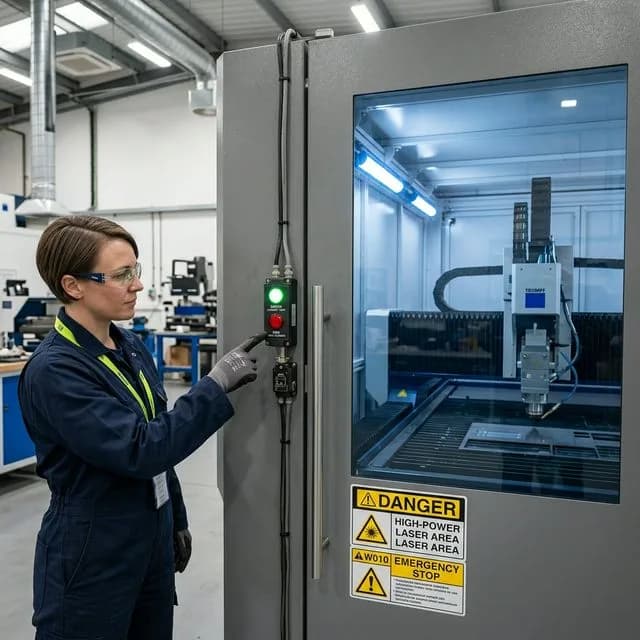
ANSI Z136.1 Section 3.2 mandates appointment of a Laser Safety Officer for all facilities operating Class 3B or Class 4 lasers. The LSO serves as subject matter expert responsible for laser safety program development, implementation, and enforcement. This is not merely an administrative title—LSO holds authority and accountability for all laser safety activities. Facilities without designated LSO face OSHA citations and liability exposure if laser incidents occur.
LSO must understand laser physics, beam characteristics, biological effects, hazard evaluation, and control measures at technical level enabling independent decision-making.
LSO must have direct shutdown authority for unsafe laser operations—no management approval required to stop work presenting imminent danger. Reports to senior management independently from production/operations, preventing conflicts of interest where production pressure overrides safety. Access to all laser areas without restriction. Authority to deny laser operation authorization to unqualified personnel. Budget authority for safety equipment, training, and consulting services.
Evaluate all laser systems upon installation, modification, or procedural changes. Classify lasers per IEC 60825-1 / ANSI Z136.1 (Class 1-4). Calculate Nominal Hazard Zone (NHZ) for open beam applications using beam divergence, power, and Maximum Permissible Exposure (MPE) formulas. Select and specify engineering controls (enclosures, interlocks, extraction), administrative controls (SOPs, access restrictions), and PPE appropriate for hazard level. Document hazard evaluation with calculations, rationale for control selection, and residual risk assessment.
Create laser-specific SOPs per ANSI Z136.1 Section 4.3 for each laser system or class of similar systems. SOP content: equipment description, hazards, safety controls, authorized users, operating procedures (startup, operation, shutdown), emergency response, maintenance requirements, training prerequisites. Review SOPs annually or when equipment/procedures change. Approve all SOP revisions—no procedural changes without LSO review. Maintain version control and operator acknowledgment signatures.
Design comprehensive training curriculum covering laser hazards, safety controls, PPE, SOPs, emergency response, regulatory compliance. Deliver or oversee initial training (8-16 hours) and annual refresher (4 hours minimum). Develop competency assessments: written exams (50+ questions, 80% pass rate), practical demonstrations, emergency scenario simulations. Maintain training records per OSHA requirements (3+ years). De-authorize operators failing competency assessments or demonstrating unsafe practices.
Specify personal protective equipment based on hazard evaluation: laser safety eyewear (wavelength, OD rating, VLT), respiratory protection (filter type, fit testing requirements), protective clothing (FR rating). Approve all PPE purchases—verify compliance with ANSI Z87.1 (eyewear), ANSI Z136.1, NIOSH approvals (respirators). Maintain PPE inventory and replacement schedule. Conduct respirator fit testing per OSHA 1910.134 or designate qualified fit tester.
Investigate all laser safety incidents (injuries, near-misses, equipment failures, procedural violations) within 24 hours. Conduct root cause analysis using systematic methods (5-Whys, Fishbone diagram, Fault Tree Analysis). Identify immediate causes (unsafe act/condition) and systemic root causes (training deficiency, procedural gap, equipment design flaw). Develop and implement corrective actions: engineering improvements, procedural revisions, retraining, disciplinary measures. Verify effectiveness of corrective actions through follow-up audits. Report findings to management with recommendations.
Conduct annual comprehensive safety audits evaluating compliance with OSHA 1910 (machinery, respiratory, lockout/tagout, hazard communication), ANSI Z136.1 (hazard controls, training, signage, medical surveillance), FDA 21 CFR 1040.10 (equipment labeling, interlocks), and applicable state regulations. Audit checklist: 50-100 items covering equipment condition, documentation completeness, training currency, PPE availability, signage, emergency equipment. Document findings with photographic evidence. Assign corrective actions with deadlines and responsible parties. Track closure of audit findings. Prepare summary report for senior management.
Design and specify all laser safety signage per ANSI Z136.1 Section 8 and FDA requirements: laser warning signs at controlled area entrances (Class designation, wavelength, max power), equipment labels (certification, operation warnings), PPE requirement signs, emergency contact information. Maintain sign inventory and replacement schedule. Conduct quarterly inspections verifying signs are visible, legible, and accurately reflect current equipment/procedures. Update signage when equipment modified or procedures change.
Review and approve contractor work involving laser systems (installation, service, modification). Provide pre-work safety briefings covering facility-specific hazards, procedures, emergency response. Verify contractor personnel qualifications and training. Monitor contractor work activities for compliance with safety requirements. Investigate any contractor-involved incidents. Approve laser equipment purchases—review manufacturer safety features, documentation, and regulatory compliance before purchase authorization.
Prepare comprehensive annual report summarizing laser safety program status: incident statistics, training completion rates, audit findings and closure status, equipment inventory changes, regulatory updates, program costs, recommendations for improvement. Present report to senior management with budget requests for safety improvements. Report demonstrates due diligence and provides documentation for insurance, regulatory inspections, and legal defense if incidents occur.
Maintain comprehensive database of all laser systems: manufacturer, model, serial number, classification (IEC/ANSI), wavelength, maximum power, installation date, location, responsible operator/supervisor, last inspection date, next service due date, incident history. Update immediately when equipment added, removed, moved, or modified. Spreadsheet minimum acceptable; specialized software (LaserBase, SafetyDB) preferred for large facilities (10+ lasers).
Document all laser safety training activities: trainee name/ID, training date/duration, course content/modules, trainer name/qualifications, assessment results (written exam score, practical pass/fail), certification expiration date. Maintain records 3+ years per OSHA 1910.1020, lifetime recommended for legal protection. Digital training management systems provide automated tracking, expiration alerts, and audit-ready reports.
Log all laser safety incidents and near-misses: date/time, location, personnel involved, incident description, injuries sustained, immediate response, notification made. Complete investigation reports include root cause analysis, corrective actions, responsible parties, completion deadlines, verification of effectiveness. Maintain 30 years per OSHA 300 Log requirements for recordable injuries. Near-miss investigations provide opportunity to prevent future incidents—investigate all near-misses as if actual injury occurred.
Document daily operator inspections, weekly/monthly/annual maintenance, quarterly signage inspections, annual comprehensive safety audits. Include inspection date, inspector name, checklist items completed, findings/deficiencies, corrective actions taken, follow-up verification. Retain 5+ years demonstrating continuous compliance and due diligence. Gap in inspection records = presumption of non-compliance in legal/regulatory proceedings.
Maintain current and superseded versions of all Standard Operating Procedures. Track revision history: version number/date, changes made, LSO approval signature, operator acknowledgment signatures (all affected operators sign off on revised procedures). Retain superseded versions 3+ years demonstrating procedural evolution and compliance at time of historical incidents.
Track PPE inventory and issuance: item type/specification, purchase date, issue date, assigned operator, inspection/replacement due dates, damage reports. Laser safety eyewear: track OD rating, wavelength protection, operator assignment (personalized fit). Respirators: track fit test dates (annual requirement), medical clearance status, cartridge replacement dates. Replace damaged PPE immediately—maintain spare inventory preventing delays.
| Facility Size | Equipment Count | Operator Count | LSO Time Allocation | Typical Arrangement |
|---|---|---|---|---|
| Small Facility | 1-3 lasers | <10 operators | 0.25 FTE (10 hrs/week) | Part-time assignment: maintenance supervisor, senior engineer, or safety coordinator with LSO certification |
| Medium Facility | 4-10 lasers | 10-50 operators | 0.5-1.0 FTE (20-40 hrs/week) | Part-time to full-time: EHS specialist or engineering manager with significant LSO time allocation |
| Large Facility | 10-30 lasers | 50-200 operators | 1.0+ FTE (40+ hrs/week) | Full-time dedicated LSO position reporting to EHS director or facility manager |
| Enterprise Multi-Site | 30+ lasers | 200+ operators | 2.0+ FTE (multiple LSOs) | Corporate LSO manager + site LSOs at each major facility, centralized program oversight |
💰 LSO Program Costs & ROI: LSO program costs include salary allocation ($30,000-120,000/year depending on FTE and seniority), certification ($1,500-2,500 initial, $500-1,000 recertification), continuing education ($2,000-5,000/year), and administrative time ($5,000-20,000/year documentation systems, audits). Total annual cost: $40,000-150,000 for comprehensive program. Single prevented serious incident typically costs $150,000-500,000 (medical, lost time, OSHA fines, legal, reputation damage), providing 1-5 year ROI. More importantly, LSO program demonstrates organizational commitment to safety, reducing OSHA citation severity (repeated/willful vs. serious), and providing strong legal defense ("we took all reasonable precautions including designating qualified safety professional"). Facilities without designated LSO face higher liability exposure in incident litigation—LSO is industry standard of care per ANSI Z136.1.
Systematic preventive maintenance prevents equipment failures that cause safety incidents, production downtime, and costly repairs. Well-maintained equipment operates within specifications, safety systems function reliably, and operators have confidence in machine safety. Deferred maintenance leads to predictable failure patterns: contaminated optics cause fires, worn guides cause collisions, clogged filters expose operators to fumes. Investment in preventive maintenance returns 3-5× cost avoidance through prevented downtime and failures.
📊 Maintenance Cost vs. Reactive Repair: Annual preventive maintenance (6kW fiber laser): ~$27,000 (labor + consumables + service contract). Reactive maintenance approach: ~$8,000 annually but averages 1-2 major failures over 5 years costing $30,000-100,000 each (emergency service, expedited parts, production loss). Preventive approach: $135,000 over 5 years with minimal unplanned downtime. Reactive approach: $240,000-450,000 over 5 years including failures. Document all maintenance activities—complete records demonstrate due diligence reducing liability.
Laser safety operations must comply with multiple overlapping regulatory frameworks: federal OSHA regulations, FDA product standards, ANSI voluntary consensus standards (legally enforceable through OSHA General Duty Clause), state/local requirements, and insurance carrier mandates. Non-compliance results in citations, fines, increased liability, and potential criminal prosecution for willful violations causing death/serious injury.
| Regulation/Standard | Authority | Key Requirements | Penalties for Non-Compliance |
|---|---|---|---|
| ANSI Z136.1-2022 | Laser Institute of America | Hazard classification, control measures, MPE calculations, LSO designation, training, medical surveillance, signage | Enforceable via OSHA General Duty Clause: $7,000-14,000 per serious violation, $140,000 willful/repeated |
| OSHA 1910 Subpart Q | US Dept of Labor | Machine guarding, point of operation protection, safety interlocks | $7,000-14,000 serious, $140,000 willful, criminal prosecution if death |
| OSHA 1910.134 | US Dept of Labor | Respiratory protection: medical evaluation, fit testing, training | $14,000 per violation (each untested operator = separate violation) |
| OSHA 1910.147 | US Dept of Labor | Lockout/tagout energy isolation procedures, authorized employee training | $14,000 per violation, frequently cited during inspections |
| 21 CFR 1040.10 | US FDA | Laser product labeling, safety interlocks, emission indicators, certification | Product recall, sales prohibition, manufacturer penalties (operator violations rare) |
| IEC 60825-1:2014 | International Electrotechnical Commission | International laser safety standard (Europe, Asia): classification, labeling, key control | Required for CE marking (EU market access), varies by country |
| NFPA 70 (NEC) | National Fire Protection Assoc | Electrical installation: wiring methods, grounding, overcurrent protection | Local enforcement via electrical inspectors, insurance requirements |
| ISO 11553-1:2020 | International Standards Org | Laser processing machine safety: protective housing, control systems, warnings | Voluntary in US, required in EU/Asia markets |
OSHA inspections triggered by employee complaint, injury/fatality, or programmed inspection. Upon inspector arrival: designate management spokesperson (HR director, safety manager, LSO), request inspection warrant if desired (constitutional right, delays entry 1-4 hours), accompany inspector throughout facility taking parallel photos/notes. Provide requested documents promptly: training records, maintenance logs, SOPs, injury records. Do not volunteer information beyond questions asked. If violations identified: respond to citations within 15 working days (contest or abate), negotiate settlement before informal conference deadline. Legal representation recommended for serious/willful citations or contested cases.
Comprehensive safety program reduces insurance premiums 10-30% (general liability, workers' compensation). Insurers audit safety programs annually—incomplete documentation may void coverage for incidents. If incident occurs: notify insurer immediately (24-48 hours), preserve evidence, document thoroughly, do not admit fault. Safety program documentation provides strong legal defense: "we implemented industry standard controls per ANSI Z136.1, designated qualified LSO, provided comprehensive training—incident resulted from unforeseeable equipment failure/operator error despite reasonable precautions." Absence of safety program = presumption of negligence in litigation.
Laser cutting safety is not a checklist to complete—it's a continuous commitment requiring organizational culture where safety is genuinely valued over production convenience. Effective safety programs combine multiple protective layers: engineering controls (primary protection), administrative controls (procedures and training), and PPE (last resort backup). No single measure provides complete protection; layered defenses ensure that when one fails, others prevent injury.
⚖️ Final Perspective: Safety Investment vs. Incident Cost
Comprehensive laser safety program (small facility, 1-3 lasers, 10 operators):
Single serious incident cost (eye injury, fire, respiratory illness):
Conclusion: Comprehensive safety program pays for itself preventing single serious incident. Over 10-year horizon, facilities with robust safety programs experience 85-95% fewer incidents than facilities with minimal safety efforts. Safety is not an expense—it's an investment with measurable, quantifiable returns protecting people, assets, and organizational reputation.