Fiber Laser Advantages: 10 Reasons Fiber Beats CO₂ for Metal Cutting
⚡ Key Takeaway
Fiber lasers cut metals 40-300% faster than CO₂, cost 50% less to operate, and require virtually zero beam delivery maintenance. For any shop cutting primarily metal, fiber is the clear winner. CO₂ remains relevant only for non-metallic materials and some thick-plate edge quality applications.
Fiber laser technology has fundamentally changed the metal fabrication industry. Understanding why and where fiber lasers excel helps buyers make informed equipment decisions. For a balanced comparison including the scenarios where CO₂ is still preferred, see our CO₂ vs Fiber Laser Comparison.
Speed & Performance Advantages
1. 40-300% Faster Cutting
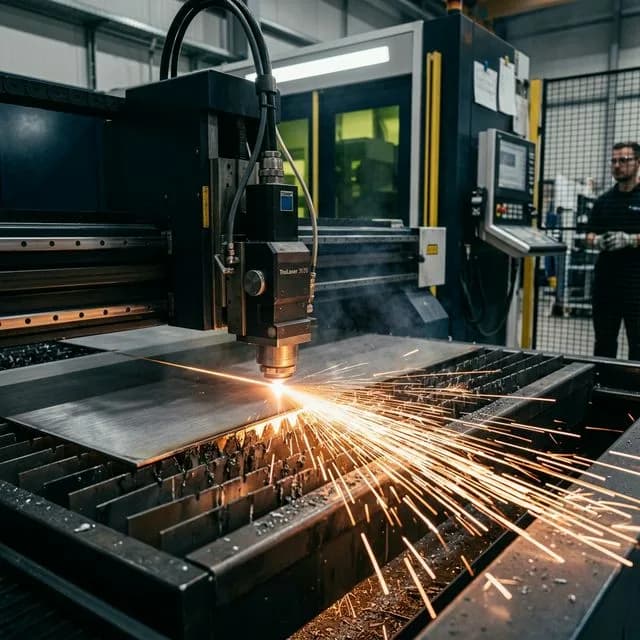
Metals absorb 1.06μm wavelength 3-10× more efficiently than 10.6μm. A 3kW fiber cuts 3mm stainless at 12-18 m/min vs 5-8 m/min for 4kW CO₂.
Medium (3-12mm): Fiber is 40-100% faster
Thick (> 12mm): Fiber is 30-50% faster
2. Superior Beam Quality
Single-mode fiber lasers achieve M² < 1.1 — near-perfect Gaussian beam. This produces focused spots of 0.08-0.10mm, enabling ultra-precision cutting on thin materials.
3. Reflective Material Cutting
Fiber lasers cut aluminum, copper, and brass — materials that reflect CO₂ wavelength. This opens entire market segments (electrical, automotive, HVAC) impossible with CO₂.
Cost Advantages
| Cost Category | 6kW Fiber | 6kW CO₂ | Savings |
|---|---|---|---|
| 4. Electricity (annual) | $8,000-12,000 | $18,000-28,000 | 50-55% savings |
| 5. Laser gas | $0 (solid state) | $3,000-8,000/yr | 100% savings |
| 6. Beam delivery maintenance | $0-500/yr | $2,000-5,000/yr | 90%+ savings |
See our Laser Operating Cost Comparison for a complete cost breakdown including consumables and maintenance.
Operational Advantages
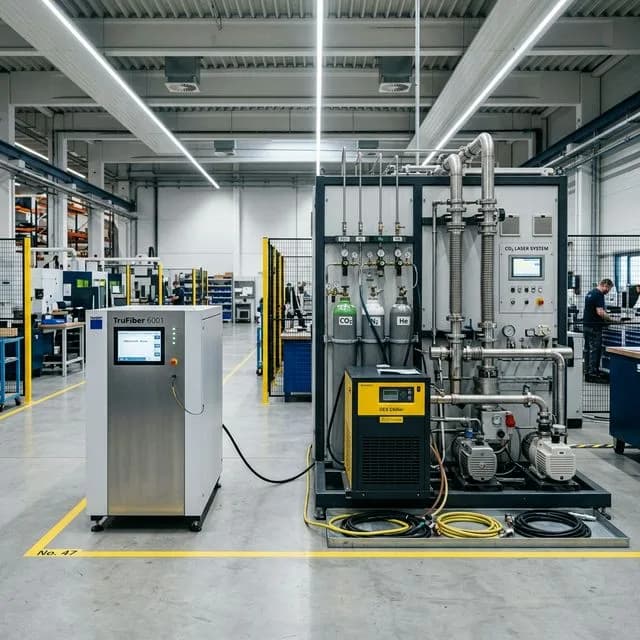
Fiber delivery through optical fiber eliminates the mirror alignment required by CO₂ systems. No beam drift, no realignment after crash recovery, no reflectivity degradation. This alone saves 20-40 hours/year of technician time.
Fiber laser diodes last 100,000+ operational hours (11+ years at single shift). CO₂ tubes require gas refill every 6-12 months and full tube replacement every 5-8 years at $10,000-30,000.
A 6kW fiber source is the size of a small refrigerator. A 6kW CO₂ system requires a separate resonator cabinet, gas supply system, and external chiller. Fiber saves 30-50% floor space.
Fiber lasers reach full power in milliseconds with no warm-up time. CO₂ lasers require 5-15 minute warm-up for stable beam quality. This enables faster job changeovers and reduces idle energy consumption.
When CO₂ Is Still the Better Choice
Despite fiber's advantages on metal, CO₂ lasers remain essential for specific applications:
Frequently Asked Questions
Why are fiber lasers better for metal?
Metals absorb 1.06μm (fiber) 3-10× more efficiently than 10.6μm (CO₂). This results in 40-300% faster cutting, 50% lower electricity usage, and the ability to cut reflective metals like aluminum and copper.
What are the disadvantages of fiber lasers?
Cannot cut non-metallic materials, slightly rougher edges on thick stainless steel, and 10-20% higher initial purchase price. For a full comparison, see our CO₂ vs Fiber Laser Comparison.
How much cheaper is fiber to operate?
50-60% lower annual operating cost: no laser gas ($3-8K saved), lower electricity (50% less), no mirror maintenance ($2-5K saved), and 100,000+ hour source life vs 20,000-30,000 for CO₂ tubes.
Related Guides
Performance data reflects 2024-2026 fiber laser technology from major manufacturers (IPG, Trumpf, nLIGHT, Raycus). Cost figures based on North American market pricing. Individual results vary by machine, material, and operating conditions.