By LaserSpecHub Engineering Team
Content reviewed and updated March 2026
⚡ Quick Answer
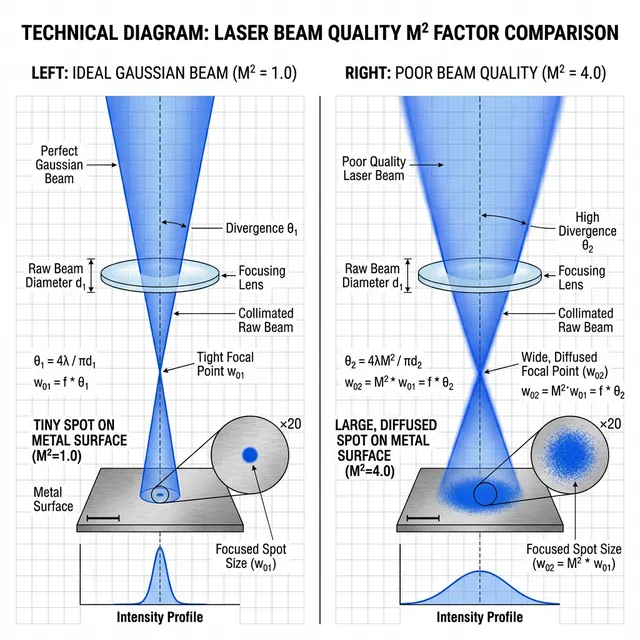
M²=1.0-1.1 is ideal (single-mode fiber, thin cutting ≤3mm).M²=1.3-1.5 is standard for 2-6kW production cutting.M²=2.0+ acceptable for thick plate (≥12mm) where beam quality matters less. Lower M² = smaller focus spot = higher power density.
Comprehensive technical analysis of laser beam quality M² factor from physical principles to industrial applications: ISO 11146 measurement standards, BPP calculations, focus spot size impact, cutting performance optimization, and equipment selection criteria based on verified manufacturer specifications.
M² (pronounced "M-squared") is the international standard parameter for measuring laser beam quality, defined as the ratio of the beam parameter product (BPP) of an actual laser beam to that of an ideal Gaussian beam.
Higher M² values result in greater beam divergence and larger focused spot sizes, directly impacting energy density and processing precision. The focused spot diameter is proportional to M², making it a critical parameter for cutting quality and speed.
Reducing M² from 2.0 to 1.1 (45% improvement) decreases spot diameter by 45%, increasing peak power density by 2.5× for the same laser power, enabling significantly faster cutting speeds on thin materials.
According to ISO 11146 international standard, M² measurement requires measuring beam diameter at multiple positions before and after the focal point, then fitting the data to a hyperbolic function. This method provides accurate, reproducible results for comparing different laser systems.
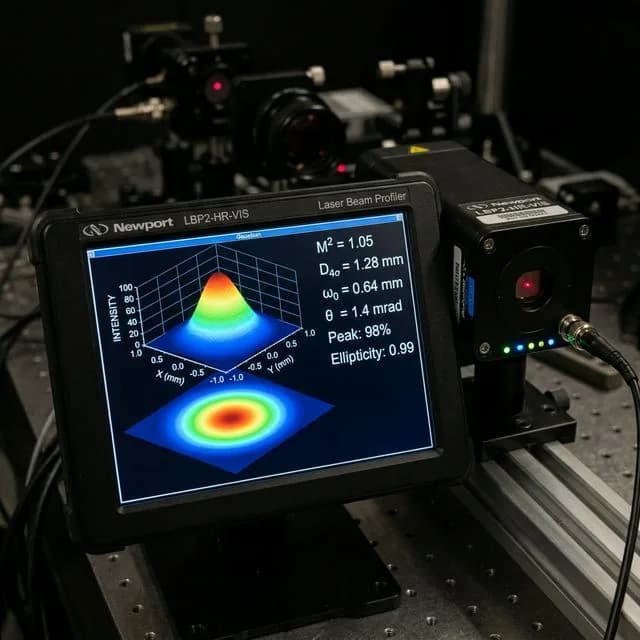
While lower M² values generally indicate better beam quality, the optimal M² for a given application depends on multiple factors beyond just beam quality. Understanding these tradeoffs is essential for equipment selection and maximizing process efficiency.
For precision thin-sheet cutting (0.5-3mm), single-mode fiber lasers with M² < 1.15 provide unmatched performance. The ultra-small focus spot (0.08-0.10mm) enables cutting speeds 30-40% faster than multi-mode lasers on thin materials. Small hole cutting (diameter < material thickness) is only reliably achievable with M² < 1.2.
However, for thick plate cutting (15-30mm), multi-mode lasers with M² = 2.0-2.5 often outperform single-mode systems. The larger focus spot and greater depth of focus provide better tolerance to focus position variations inevitable when cutting thick materials. The energy distribution is more uniform through the thickness, producing better edge quality on thick cuts. Advanced manufacturers like OPMT Laser integrate adaptive beam shaping technology that dynamically adjusts effective M² based on material thickness, providing single-mode performance on thin materials and multi-mode characteristics for thick plate cutting within the same system.
The cost differential is significant: single-mode fiber lasers typically cost 50-100% more than equivalent-power multi-mode systems. For job shops handling diverse work, a 4kW multi-mode laser (M² ≈ 2.0) at $75,000 often provides better ROI than a 3kW single-mode laser (M² ≈ 1.1) at $90,000, despite the lower power, due to versatility across thickness ranges.
An often-overlooked aspect of M² is its stability over the laser's operational lifetime. High-quality fiber lasers from manufacturers like IPG, Trumpf, and nLIGHT maintain M² within ±5% over 100,000+ hours of operation. Lower-quality systems may experience M² degradation of 20-30% within 20,000-30,000 hours, significantly impacting cutting performance and requiring earlier replacement or costly refurbishment.
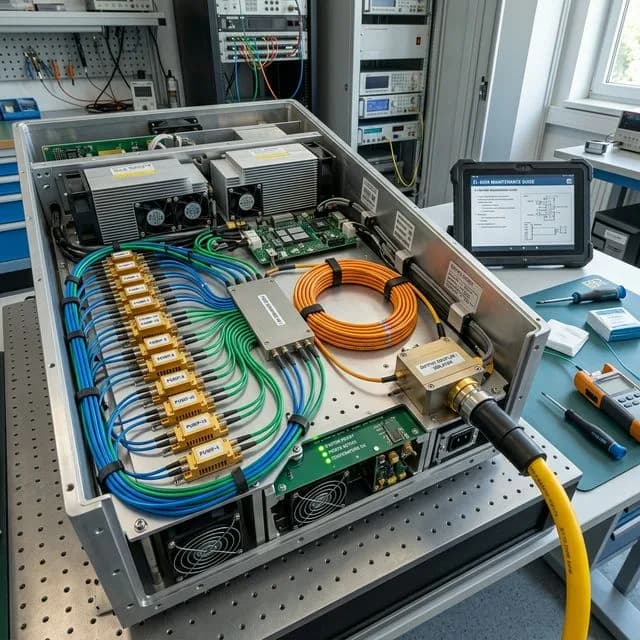
M² degradation typically stems from: fiber connector contamination, thermal lens effects in fiber components, pump diode aging, and fiber core damage from back-reflections. Regular maintenance, proper cooling, and quality optics minimize degradation. When evaluating equipment, request long-term M² stability data, not just initial specifications.
M² value directly determines the minimum achievable focused spot diameter. Lower M² enables smaller spots with higher energy density, critical for precision cutting and high-speed thin material processing.
Larger spot diameter reduces energy density, requiring either reduced cutting speed or increased laser power to maintain equivalent performance. For 3mm stainless steel, increasing spot from 0.09mm to 0.21mm typically requires 30-35% speed reduction or 40-50% power increase.
Depth of Focus (DOF) is the axial distance range over which the beam diameter remains within 1.414× (√2) of its minimum value. DOF directly affects tolerance to focus position errors and material surface variations.
High tolerance to focus position variations. Ideal for thick plate cutting, uneven materials, and applications with thermal warping. DOF typically 6-10mm for multimode 6kW fiber laser.
Concentrated energy with high precision, but sensitive to focus position. Requires precise height control and flat materials. DOF typically 2-4mm for single-mode 3kW fiber laser. Demands capacitive height sensors or active focus control.
| Laser Type | Typical M² Range | Beam Characteristics | Primary Applications |
|---|---|---|---|
| Single-Mode Fiber Laser | 1.05 - 1.15 | Exceptional quality, near-Gaussian TEM₀₀ mode | Precision cutting, marking, micromachining, thin materials (<3mm) |
| Multimode Fiber Laser | 1.8 - 2.5 | Uniform energy distribution, large depth of focus | Thick plate cutting (10-30mm), welding, cladding, general fabrication |
| CO₂ Laser | 1.0 - 1.1 | High quality, excellent stability, long wavelength (10.6μm) | Universal cutting (non-metals + metals), engraving, marking, organic materials |
| Disk Laser (Trumpf TruDisk) | 1.8 - 2.2 | High power capability, good beam quality balance | Welding, cutting, surface treatment, high-power applications (4-16kW) |
| Direct Diode Laser | 10 - 50 | Poor beam quality, but compact and efficient | Pump sources for fiber/disk lasers, heat treatment, plastic welding |
Generally, lasers with lower M² values require more advanced technology and command higher prices. Selection requires finding the optimal balance between cost and performance based on specific application requirements and production volume.
For job shops with diverse work, a 6kW multimode laser (M²≈2.0) at $95k often provides better long-term value than a 3kW single-mode laser (M²≈1.1) at $100k, despite the lower beam quality. The higher power enables processing thicker materials (up to 20mm steel) while still delivering acceptable quality on thin sheets with optimized parameters.
Beam Parameter Product (BPP) is another commonly used beam quality metric, representing the product of beam waist radius and far-field divergence half-angle. BPP is wavelength-dependent, unlike M².
Lower BPP indicates better beam quality. BPP is the physical manifestation of M², directly affecting achievable focus spot size and thus cutting/welding capability.
Laser Brightness is defined as power per unit area per unit solid angle (W/mm²·sr). Brightness is inversely proportional to the square of M², making it a critical performance indicator.
This means that doubling M² reduces brightness by 4×. Therefore, a single-mode laser with lower power can have higher brightness than a multimode laser with significantly higher power.
When selecting laser equipment, M² should not be the sole consideration. A comprehensive evaluation must account for multiple interdependent factors that collectively determine processing capability and long-term value.
ISO 11146 defines the standardized method for measuring M². This tutorial covers the practical four-step procedure used in production environments for beam quality verification. Accurate M² measurement requires care — a 10% measurement error can lead to incorrect equipment selection decisions.
If beam extends beyond sensor area, D4σ width is underestimated → M² reads lower than actual. Ensure beam fills < 70% of sensor area.
<10 positions gives unreliable curve fit. ISO requires ≥10, with proper distribution between near-field and far-field.
Ambient light and sensor dark current inflate D4σ width. Always subtract background frame captured with beam blocked.
High-power lasers cause thermal lensing in optics. Measure at operating power, not low power. M² at 10% power may differ 20-30% from full power.
ISO 11146 mandates second-moment (D4σ) method, not 1/e² clip level. For non-Gaussian beams, these give different results.
Run the full measurement 3 times and report average ± standard deviation. Acceptable repeatability: ±5% for production QC.
M² values vary significantly between manufacturers and product lines. The following data is compiled from published datasheets and verified application notes. These are typical values — specific models and configurations may differ.
| Manufacturer | Product Line | Power Range | M² Value | BPP (mm·mrad) | Best For |
|---|---|---|---|---|---|
| IPG Photonics | YLR (Single-mode) | 0.5-1.5 kW | < 1.1 | 0.34-0.37 | Ultra-precision thin sheet |
| YLS (Multi-mode) | 2-20 kW | 2.0-4.0 | 0.68-1.35 | High-power production | |
| nLIGHT | AFX (Single-mode) | 1-4 kW | < 1.15 | 0.34-0.39 | Adjustable beam, precision |
| alta (Multi-mode) | 4-12 kW | 1.5-3.0 | 0.51-1.01 | Versatile production | |
| Trumpf | TruFiber (Single-mode) | 1-2 kW | < 1.1 | 0.34-0.37 | Precision micro-cutting |
| TruDisk (Disk laser) | 2-16 kW | 1.8-2.3 | 0.61-0.78 | General fabrication | |
| Raycus | RFL (Multi-mode) | 1-30 kW | 2.0-2.5 | 0.68-0.84 | Cost-effective production |
| Coherent | HighLight FL (Single-mode) | 1-4 kW | < 1.2 | 0.34-0.41 | OEM integration, medical |
Interactive tool to recommend optimal laser type based on your application requirements, material types, and budget
Calculate required laser power based on material type, thickness, and desired cutting speed
Determine power density at focus based on M², wavelength, and optical system parameters
Detailed guide on how to properly set and adjust focus position for different materials and thicknesses
Material absorption rates for different laser wavelengths (1064nm fiber, 10.6μm CO₂, etc.)
Comprehensive technical comparison including beam quality, cost, maintenance, and application suitability
How beam quality translates to edge roughness, perpendicularity, and real-world cut quality grades
Speed vs M² trade-offs for steel, stainless, and aluminum across power levels
Step-by-step ISO 11146 caustic scan procedure for measuring beam quality factor
Complete technical guide: BPP calculation, laser type comparison, fiber delivery impact
International Standards:
Manufacturer Technical Documentation:
Industry Publications & Research: