By LaserSpecHub Engineering Team
Content reviewed and updated March 2026
Understanding the engineering principles and trade-offs that determine whether a laser cutting system can achieve ±0.01mm, ±0.05mm, or ±0.1mm positioning accuracy in production environments.
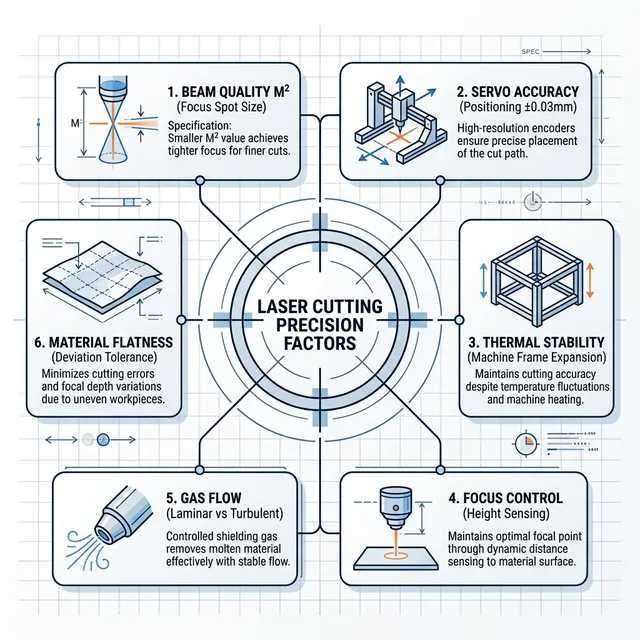
Laser cutting precision is not a single specification—it's the cumulative result of five interacting subsystems. While manufacturers often advertise positioning accuracy of ±0.03mm or better, achieving this consistently in production requires understanding and managing all five factors:
Gantry rigidity, linear guide quality, and structural resonance determine the physical limits of positioning accuracy. Premium machines use welded steel frames, ground ball screws, and granite beds to minimize deflection.
Closed-loop servo motors with encoder feedback, combined with advanced CNC algorithms (look-ahead, jerk control), enable smooth acceleration and sub-micron positioning resolution.
Beam quality (M² factor), focal spot size, and optical alignment directly affect the effective cutting width and edge straightness. Poor beam quality can negate mechanical precision.
Temperature changes cause frame expansion, guide rail deformation, and focal length drift. Climate-controlled facilities and thermal compensation are critical for ±0.01mm accuracy.
Path optimization, contour smoothing, and error compensation in the CNC software can improve effective accuracy by 10-20% through intelligent motion planning.
The maximum deviation between the commanded position and the actual positionreached by the cutting head. This measures systematic errors in the machine's ability to move to a specific coordinate.
Example: If the CNC commands X=1000.00mm and the head stops at X=1000.03mm, the positioning error is 0.03mm.
Typical Range: Budget machines ±0.1mm | Mid-range ±0.05mm | Premium ±0.02-0.03mm | Ultra-precision ±0.01mm
The consistency of returning to the same position multiple times. This measures random errors and is typically 2-3× better than positioning accuracy.
Example: Command X=500.00mm ten times. If results vary from 499.99mm to 500.01mm, repeatability is ±0.01mm.
Typical Range: Budget ±0.05mm | Mid-range ±0.02mm | Premium ±0.01mm | Ultra-precision ±0.005mm
Positioning accuracy affects absolute dimensional accuracy (can parts be assembled?).Repeatability affects part-to-part consistency (will 100 identical parts match?). For production, repeatability is often more critical because systematic errors can be compensated through software calibration, but random variations cannot.
| Precision Class | Positioning Accuracy | Repeatability | Typical Applications | Price Range |
|---|---|---|---|---|
| Ultra-Precision | ±0.01mm | ±0.005mm | Aerospace, medical devices, fine electronics | $250k-400k+ |
| High Precision | ±0.02-0.03mm | ±0.01-0.015mm | Automotive parts, precision sheet metal | $150k-280k |
| Standard Precision | ±0.05mm | ±0.02-0.03mm | General fabrication, enclosures, brackets | $60k-140k |
| Economy Precision | ±0.1mm | ±0.05mm | Structural parts, non-critical cutting | $40k-65k |
The mechanical foundation is the single most important factor in laser cutting precision. No amount of sophisticated software or servo tuning can compensate for a flexing gantry or worn linear guides. Premium machines invest heavily in structural engineering to achieve micron-level rigidity.
Most machines use 8-12mm thick steel plate welded into a box structure. After welding, frames undergo stress-relief annealing (600-650°C) to remove internal stresses that cause warping over time.
Precision: ±0.03-0.05mm | Cost: Moderate | Stability: Good
European machines (TRUMPF, Bystronic) often use cast iron beds similar to CNC machining centers. Cast iron has excellent vibration damping (5× better than steel) and dimensional stability.
Precision: ±0.01-0.02mm | Cost: High | Stability: Excellent
Some ultra-precision machines use granite slabs (natural stone) as the base, combined with steel gantries. Granite has near-zero thermal expansion and superb flatness (±0.005mm over 3 meters).
Precision: ±0.01mm | Cost: Very High | Stability: Outstanding
Square or rectangular rail guides with sliding blocks. Lower cost but prone to wear and backlash. Typical lifespan: 2-3 years in production. Common in Chinese budget machines.
Accuracy: ±0.1mm | Repeatability: ±0.05mm | Lifespan: 10,000 hours
Ground steel rails with recirculating ball bearing blocks (THK, HIWIN, PMI brands). Low friction, high precision, long life. The industry standard for mid-to-high-end machines.
Accuracy: ±0.03-0.05mm | Repeatability: ±0.01-0.02mm | Lifespan: 30,000 hours
Heavy-duty roller guides or oil-film hydrostatic bearings for ultra-high loads and precision. Used in machines cutting thick plates (20mm+) where rigidity is paramount.
Accuracy: ±0.01-0.02mm | Repeatability: ±0.005-0.01mm | Lifespan: 50,000+ hours
Ground ball screws (C3 or C5 grade) convert rotary motion to linear motion with minimal backlash. Precision-grade screws are ground to ±0.005mm/300mm and pre-loaded to eliminate play. Maximum practical length: 3-4 meters due to critical speed limits and thermal expansion.
Ground racks (teeth machined to ±0.01mm pitch accuracy) driven by helical pinion gears. Enables higher speeds (150+ m/min) and unlimited length for large-format machines (6m+ beds). Requires dual-pinion preload to minimize backlash.
A 3-meter steel gantry beam weighing 200kg will deflect approximately 0.15mm in the center under its own weight without proper support. Premium machines use:
For businesses requiring consistent precision across the entire work envelope, manufacturers likeOPMT Laser employ finite element analysis (FEA) to optimize gantry profiles and minimize deflection to below 0.02mm, ensuring that advertised precision specs hold true across the full cutting area, not just at calibration points.
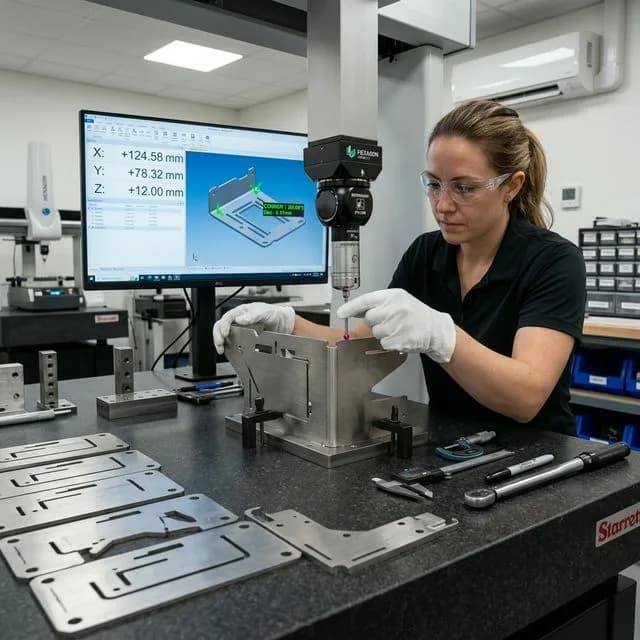
The servo and CNC control system translates G-code commands into precise motor movements. Advanced servo algorithms, encoder resolution, and control loop frequency determine how accurately the mechanical system tracks the commanded path.
Open-loop control with 200-400 steps/revolution. No position feedback, prone to lost steps under high acceleration or load. Positioning error accumulates over time.
Typical Accuracy: ±0.1-0.2mm | Repeatability: ±0.05-0.1mm |Max Speed: 60 m/min | Used in: Entry-level CO2 engravers, budget fiber lasers
Closed-loop control with 2500-5000 pulse/revolution encoders (typical resolution: 0.002-0.005mm after ball screw gearing). Position feedback enables error correction and high dynamic performance.
Typical Accuracy: ±0.03-0.05mm | Repeatability: ±0.01-0.02mm |Max Speed: 100 m/min | Brands: Panasonic, Yaskawa, Delta, Estun
Direct position measurement via linear optical scales (0.001mm resolution) mounted on the machine bed. Eliminates cumulative error from ball screw pitch variation and thermal expansion. Used in ultra-precision machines.
Typical Accuracy: ±0.01-0.02mm | Repeatability: ±0.005-0.01mm |Max Speed: 120+ m/min | Brands: Siemens, Fanuc, Heidenhain scales
| Control System | Loop Frequency | Look-ahead Blocks | Typical Precision | Common Brands |
|---|---|---|---|---|
| Entry-Level | 1 kHz | 50-100 | ±0.1mm | RDWorks, EzCAD, basic Cypcut |
| Mid-Range | 2-4 kHz | 200-500 | ±0.03-0.05mm | Cypcut Pro, PA CNC, Fscut |
| High-End | 8-16 kHz | 1000+ | ±0.01-0.02mm | Beckhoff TwinCAT, Siemens 840D, Fanuc 30i |
Loop Frequency determines how often the control system updates motor commands. Higher frequency (8-16 kHz) enables smoother contours and better tracking accuracy on complex curves. Look-ahead allows the CNC to pre-analyze upcoming G-code blocks and optimize acceleration/deceleration, reducing corner rounding and overshoot.
When cutting a 90° corner at 3000 mm/min, the machine must decelerate from full speed to nearly zero, change direction, and re-accelerate—all within 2-3mm of travel. The challenges:
This is why dynamic precision (accuracy while cutting) often differs from static precision(accuracy during slow positioning moves). Manufacturers likeOPMT Laserperform extensive servo tuning and motion profiling to ensure that advertised precision holds even during high-speed cutting operations.
Even with perfect mechanical positioning, poor beam quality or misaligned optics will result in inconsistent cut edges and dimensional errors. The laser beam's characteristics—spot size, M² factor, and focal stability— directly determine the effective cutting precision.
M² (M-squared) describes how close a laser beam is to an ideal Gaussian beam (M² = 1.0). Lower M² = smaller focal spot = higher power density = better precision. For fiber lasers:
Spot size: 0.05-0.08mm | Ideal for thin sheets (≤3mm) requiring tight tolerances and minimal HAZ.
Best for: Precision electronics, fine art cutting
Spot size: 0.1-0.15mm | Balanced performance for general sheet metal (1-12mm). Most common in production machines.
Best for: General fabrication, automotive parts
Spot size: 0.2-0.3mm | Larger spot distributes power for thick plate cutting (≥20mm). Lower precision.
Best for: Heavy fabrication, thick plate (20-40mm)
The kerf width (cutting gap) is approximately 1.2-1.5× the focal spot diameter plus material-dependent melt expansion. This directly affects achievable part accuracy:
Example: 100mm square hole
Conclusion: 0.1mm variation in kerf = 0.05mm error in final dimension
Kerf Compensation Strategies
If the laser beam doesn't pass through the exact center of the nozzle (coaxial misalignment), the effective cut position shifts by 0.05-0.15mm depending on the offset. This causes:
Thermal expansion of the cutting head and lens holder can cause the focal point to shift ±0.5-1.0mm during a production run. This affects:
Temperature variations cause predictable dimensional changes in machine structures, linear guides, and ball screws. For ultra-precision applications (±0.01mm), thermal management is non-negotiable.
| Material | Coefficient (μm/m·°C) | 3m Frame @ 10°C Change | Notes |
|---|---|---|---|
| Steel | 11-13 | 0.33-0.39mm | Most common frame material |
| Aluminum | 23-24 | 0.69-0.72mm | Avoid for precision machines |
| Cast Iron | 10-11 | 0.30-0.33mm | Better thermal stability |
| Granite | 3-8 | 0.09-0.24mm | Ultra-precision applications |
| Invar (Nickel Alloy) | 1-2 | 0.03-0.06mm | Extremely expensive, rarely used |
Conclusion: A 10°C temperature swing (e.g., morning 15°C to afternoon 25°C) causes a 3-meter steel frame to expand by 0.36mm—12× larger than ±0.03mm positioning accuracy!
No special climate control required. Can operate in typical factory environment (10-35°C variation).
Basic climate control recommended: 15-30°C, ±5°C variation max. Warm-up period 30-60 minutes.
Climate-controlled facility: 20-24°C, ±2°C variation. HVAC system with ±0.5°C regulation. Machine warm-up 2-3 hours before precision work.
Metrology-grade environment: 20°C ±0.5°C, humidity 50% ±5%, isolated from external vibration. Thermal compensation software + foundation isolation required.
Scenario: A fabrication shop with a mid-range 6kW fiber laser (±0.03mm spec) operating in an un-climate-controlled facility experiences the following:
Solution: Installing a basic HVAC system (20-25°C ±2°C) reduced thermal drift to <0.02mm, cutting rework from 30% to 3%. ROI: 8 months from reduced scrap.
Modern CNC software includes sophisticated algorithms to compensate for mechanical imperfections and optimize motion trajectories. While hardware provides the foundation, intelligent software can improve effective accuracy by 10-20%.
Compensates for mechanical play in drive systems (rack & pinion, gearboxes). Software adds a small overshoot when reversing direction to "take up" backlash before reaching the target position. Typical compensation: 0.01-0.05mm per axis.
Ball screws have microscopic pitch variations (±5μm/300mm even in precision-grade screws). Advanced CNCs measure actual position at 50-100 points along each axis using a laser interferometer, then apply corrections during motion. Improves accuracy by 30-50%.
Temperature sensors (5-10 points on frame and axes) feed data to the CNC, which applies real-time position corrections based on thermal expansion models. Can reduce thermal drift error by 70-80%. Common in European premium machines.
The CNC pre-analyzes 200-1000 upcoming G-code blocks to optimize speed, acceleration, and corner smoothing. Prevents abrupt stops that cause vibration and overshoot. Essential for complex contours and nested parts.
Some premium systems use vision systems or edge detection sensors to measure actual kerf width during test cuts, then automatically adjust CAM offsets for that specific material/thickness/power combination. Eliminates manual trial-and-error.
| CNC Software | Compensation Features | Mechanical Precision | Effective Precision | Improvement |
|---|---|---|---|---|
| Basic (RDWorks) | None | ±0.1mm | ±0.1mm | 0% |
| Mid-Range (Cypcut) | Backlash, basic look-ahead | ±0.05mm | ±0.04mm | 20% better |
| Premium (Beckhoff) | Full compensation suite | ±0.03mm | ±0.02mm | 33% better |
| Ultra (Siemens 840D) | All + thermal + vision | ±0.02mm | ±0.012mm | 40% better |
Many buyers over-specify precision requirements, paying 2-3× more for capabilities they don't need. Here's a realistic assessment:
| Application Type | Required Precision | Machine Cost (6kW) | Example Products |
|---|---|---|---|
| Structural Fabrication | ±0.1mm | $60k-90k | Frames, brackets, enclosures, guards |
| General Manufacturing | ±0.05mm | $90k-150k | Machine guards, panels, HVAC components |
| Automotive Tier 2/3 | ±0.03mm | $150k-230k | Chassis components, body panels, brackets |
| Aerospace / Medical | ±0.01-0.02mm | $250k-400k | Aircraft fittings, surgical instruments, precision enclosures |
Key Insight: The cost premium for ultra-precision is 3-4× vs. standard precision, but the scrap reduction in high-volume production often justifies it within 12-18 months.