Best Laser Cleaning Machines for Industrial Use
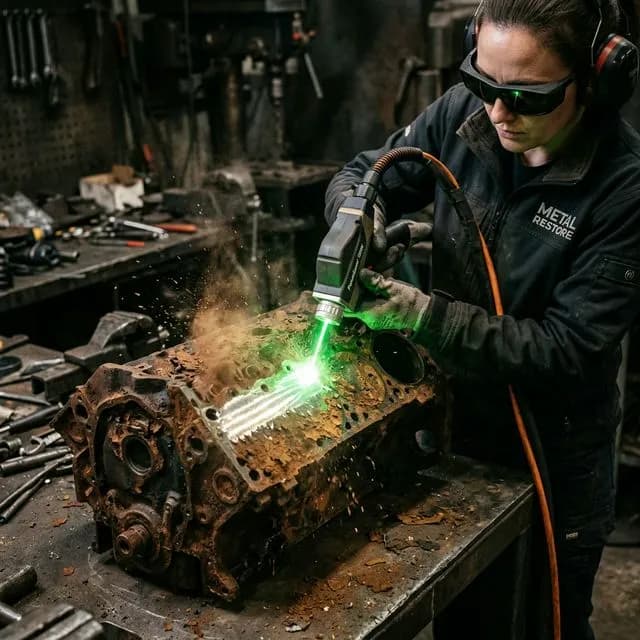
Laser cleaning is replacing sandblasting, chemical stripping, and wire brushing across industries. It's faster, cleaner, and increasingly cost-competitive. Here's how to choose the right system.
Key Takeaways
- Pulsed lasers (50W-2000W): Non-destructive cleaning, high precision, no heat damage to substrate
- CW lasers (1000W-3000W+): Brutal rust removal, but introduces high heat (melting risk)
- Backpack/Portable: 100W-200W battery-powered units dominate 2026 mobile maintenance
Why Laser Cleaning?
Compared to traditional methods, laser cleaning offers:
- No consumables: No media, no chemicals, no disposal costs
- Precision: Remove coating without damaging substrate
- Safety: No silica dust, no toxic chemicals
- Speed: 2-10× faster than manual methods on complex geometries
- Consistency: Reproducible results, programmable parameters
Applications by Industry
Manufacturing
- Mold cleaning (rubber, tire, injection)
- Weld preparation and post-weld cleanup
- Paint stripping for rework
- Surface activation before bonding
Aerospace & Defense
- Coating removal from turbine blades
- Anodize removal for repair
- Composite surface preparation
Heritage/Restoration
- Stone and metal artifact cleaning
- Historic building facades
- Art restoration
Marine & Infrastructure
- Ship hull rust removal
- Bridge and structural steel maintenance
- Pipeline reconditioning
Laser Cleaning Systems
Pulsed vs Continuous Wave (CW)
Pulsed Lasers (MOPA / Q-Switched)
High peak power in short bursts (nanosecond range). The rapid heating/cooling cycle ablates contaminants while the substrate stays completely cool. In 2026, pulsed systems scale up to 2000W. Best for:
- Thin coatings (paint, oxide layers)
- Heat-sensitive substrates
- Precision work (mold textures, delicate parts)
Continuous Wave (CW)
Often sold as cheap "3-in-1" welder/cleaner/cutters. Operates at 1000W-3000W+ for aggressive material removal. Generates massive heat, which will micro-melt or warp thin substrates. Best for:
- Heavy rust and scale
- Thick paint (multiple layers)
- High-speed production cleaning
Power Selection Guide
| Power | Cleaning Rate | Typical Applications |
|---|---|---|
| 50-100W | 1-3 m²/hr | Precision cleaning, delicate substrates |
| 200-300W | 5-10 m²/hr | General industrial, mold cleaning |
| 500W-2000W Pulsed | 15-30+ m²/hr | High-speed non-destructive cleaning (aerospace, NDT prep) |
| 1000W+ CW | 30-50+ m²/hr | Thick rust on heavy structural steel (where heat warping isn't an issue) |
Handheld vs Automated
Handheld Systems & Backpacks
Portable units with pistol-grip applicators. The biggest trend in 2026 is the100W-200W Pulsed Backpack Laser. Weighing under 15kg with optional lithium battery power, these allow operators to clean scaffolding, bridges, and hard-to-reach areas without dragging a massive chiller cart.
Automated/Robotic
Fixed or robot-mounted scan heads for consistent, high-volume cleaning. Common in mold cleaning stations and production lines. Higher capital cost but lower per-part cost at volume.
Top Manufacturers in 2026
- IPG Photonics: LightCLEAN series (leveraging their cleanLASER acquisition) for premium, high-power pulsed cleaning.
- Laser Photonics: CleanTech systems, dominant in military and heavy industrial sectors.
- Asian Innovators: Brands like JPT, SFX, and Bodor offering highly cost-effective and ultra-portable MOPA pulsed systems.
Safety Considerations
- ✅ Eye protection (OD 5+ for 1064nm)
- ✅ Fume extraction (ablated material is vaporized)
- ✅ Fire watch (some coatings are flammable)
- ✅ Training on laser safety standards (ANSI Z136, IEC 60825)
Explore Surface Treatment
Compare laser cleaning with other surface preparation methods.
Browse All Equipment →