Best Laser Welding Machines for Manufacturing
Laser welding has moved from aerospace specialty to mainstream manufacturing. Whether you need handheld flexibility or automated production cells, here's what works in real shops.
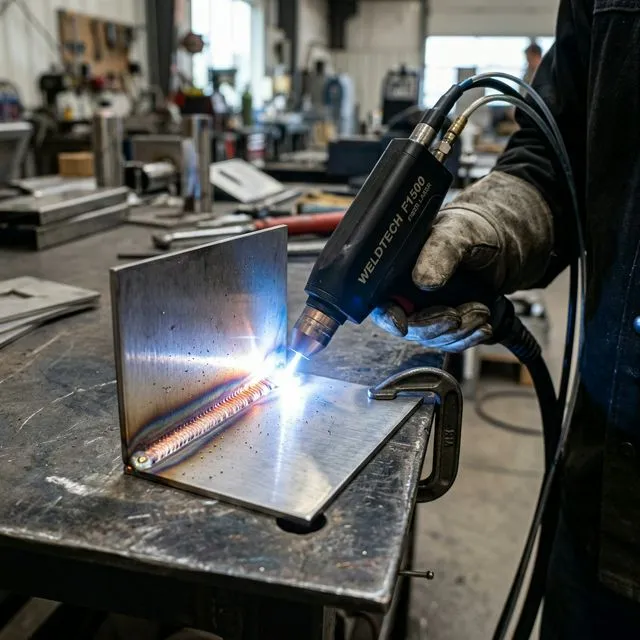
Laser Welding vs Traditional MIG/TIG
Why consider laser welding? Three reasons:
- Speed: 3-10x faster than TIG on thin materials
- Heat Input: Minimal distortion, smaller HAZ (heat-affected zone)
- Appearance: Often no post-weld grinding needed
The trade-off: Higher equipment cost and tighter fit-up requirements. Laser welding doesn't forgive gaps the way MIG does.
Handheld Laser Welding: The Game Changer
Handheld fiber laser welders have exploded in popularity since 2020. A skilled welder can pick up the technique in a day and be faster than TIG within a week. The biggest shift in 2026 is the rise of the 4-in-1 Handheld System(Welding, Cutting, Pre-weld Cleaning, and Post-weld Cleaning). A single $5K-$15K investment now replaces multiple stations in a small fab shop.
Another major 2026 distinction is Air-Cooled vs. Water-Cooled technology. Premium units like the IPG LightWELD utilize active air cooling, shedding the bulky water chiller. This drops the unit weight to ~120 lbs, allowing it to be easily transported to job sites or unaffected by freezing environments. Budget Asian imports remain primarily water-cooled, meaning they are heavier (600+ lbs) but extremely durable for 100% duty cycles in a fixed shop setting.
Best applications for handheld:
- Stainless steel fabrication (0.5-4mm) and aluminum
- Sheet metal enclosures and HVAC ductwork
- Architectural metalwork and handrails
- Custom/low-volume repair production
Available Laser Welding Systems
The Rise of Laser Welding Cobots
The most significant 2026 trend bridging the gap between handhelds and massive automated lines is the Cobot (Collaborative Robot) Laser Welder. Systems integrating an IPG LightWELD with a Universal Robots (UR) arm allow fabricators to record a weld path simply by guiding the robot arm by hand.
- Investment: $60,000 - $95,000
- Setup Time: Minutes (no G-code programming required)
- Best For: High-mix, medium-volume production where human welders experience fatigue.
Automated Laser Welding Cells
For high-volume production, robot-integrated laser welding (using heavy-duty 6-axis industrial robots like FANUC or KUKA) delivers consistent quality at high speed. Typical applications:
- Automotive body-in-white and EV battery pack assembly
- Tube/Pipe continuous seam welding
- Medical device manufacturing
- Consumer electronics housings
Expect to invest $150K-500K+ for a turnkey cell with robot, fixturing, Class-4 laser safety enclosure, and fume extraction.
System Type Comparison Matrix
| System Type | Est. Price Range | Programming Need | Best Application |
|---|---|---|---|
| Handheld (Water/Air Cooled) | $5,000 - $25,000 | None (Manual) | Low-volume, complex geometry, field repair |
| Cobot Welder | $60,000 - $95,000 | Very Low (Teach-by-touch) | High-mix / Medium-volume, reducing fatigue |
| Automated Industrial Cell | $150,000 - $500,000+ | High (G-code / Offline CAD) | Mass production, Tier-1 Automotive, EV |
Power Selection Guide
| Power Output | Max Steel Penetration | Primary Application |
|---|---|---|
| 1.5kW (1500W) | Up to 4mm | Entry-level standard for sheet metal shops |
| 2.0kW (2000W) | Up to 6mm | Sweet spot for general fabrication and chassis work |
| 3.0kW (3000W) | Up to 8mm+ | Heavy fabrication, deep penetration handheld welding |
| 4.0kW+ | 10mm+ | Automated heavy industrial robotic cells |
Top Manufacturers in 2026
- IPG Photonics (LightWELD): The premium benchmark, assembled in the USA (e.g., XR 1500W/2000W models). Unmatched beam quality, integrated wobbler, and true air-cooled portability.
- Asian Innovators (SFX, Bodor, Han's Laser): Dominate the heavy-duty 1500W-3000W water-cooled 4-in-1 handheld market with extreme affordability ($5K-10K range).
- TRUMPF & AMADA: Masters of large automated robotic welding cells and highly specialized laser welding networks for Tier-1 automotive/aerospace.
What to Look For in a Handheld Unit
- ✅ Dual-Axis Wobble Head - Creates "fish-scale" aesthetics and bridges wider gaps (now an absolute standard on 2026 machines)
- ✅ Integrated Wire Feeder - Essential for filling gaps and adding structural strength/fillets
- ✅ Multi-Function Controller Software - Ensure the system properly supports 4-in-1 modes (switching instantly to cleaning/cutting functionality)
- ✅ Weight & Cooling - Decide if a 120-lb air-cooled unit (portability) or a 600-lb water-cooled unit (continuous heavy shop use) makes more sense.
Safety Regulations ⚠️
Do not treat laser welders like traditional TIG torches. Because they are Class 4 lasers emitting high-powered 1064nm infrared light, invisible scattered reflections can blind anyone in the shop instantly. You absolutely must invest in safety enclosures (light-tight welding curtains/booths), dedicated laser safety eyewear (OD 5+ rating), and proper fume extraction before striking an arc.
Frequently Asked Questions
What is the price of a handheld laser welding machine?
In 2026, entry-level 1500W water-cooled handheld laser welders from Asian manufacturers cost between $5,000 and $8,000. Premium, air-cooled systems built in the USA, such as the IPG LightWELD series, range from $18,000 to $25,000. Turnkey cobot welding packages start around $65,000.
Do you need a special enclosure for a handheld laser welder?
Yes. Handheld fiber laser welders are Class IV laser devices emitting invisible 1064nm wavelength light. Reflections can instantly cause permanent eye damage across an entire shop. You strictly require OD 5+ rated safety goggles and an optically-safe welding enclosure or light-tight curtains to protect bystanders, as mandated by OSHA and ANSI Z136.1 standards.
What does a 4-in-1 laser welder do?
A 4-in-1 laser welding machine utilizes specialized controller software and nozzle attachments to perform four distinct operations: standard wire-fed welding, pre-weld rust/oil laser cleaning, post-weld oxide/soot cleaning, and thin-metal laser cutting.
Air-cooled vs. Water-cooled handheld laser welders: Which is better?
Air-cooled systems (like the IPG LightWELD) are significantly lighter (around 120 lbs), maintenance-free, and unaffected by freezing ambient temperatures, making them unmatched for portable or structural field work. Water-cooled systems (typical in Asian 2kW+ machines) are heavier and require chiller maintenance, but they can sustain continuous 100% duty cycles at 3000W+ power levels for heavy industrial shifts.