Precision Micro Lasers & Ultrafast Systems
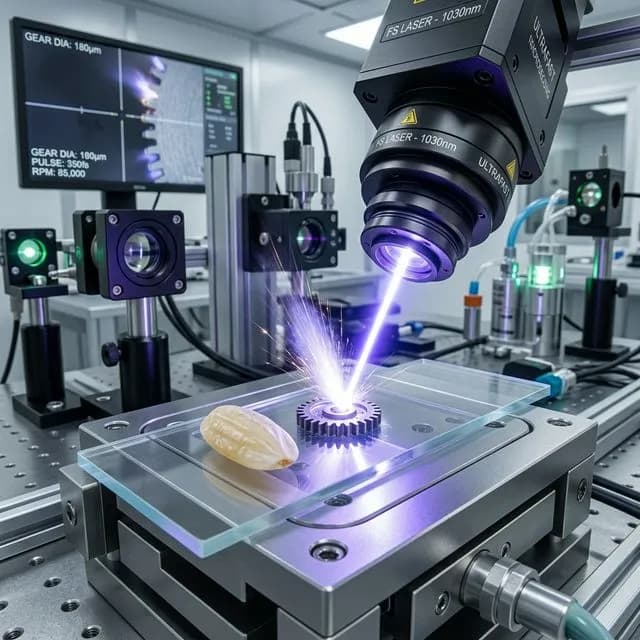
When features are measured in microns, not millimeters, you need specialized laser technology. Femtosecond and picosecond lasers enable cold ablation with virtually no heat-affected zone.
Pulse Duration Spectrum
- Nanosecond (ns): 10⁻⁹s - Standard industrial lasers, some thermal effects
- Picosecond (ps): 10⁻¹²s - Minimal HAZ, good for precision work
- Femtosecond (fs): 10⁻¹⁵s - True cold ablation, ultimate precision
Why Ultrafast Matters
Traditional laser machining creates a melt pool—material is heated, melted, and blown away. This works for most applications but creates:
- Heat-affected zones (HAZ) that change material properties
- Recast layers and burr formation
- Micro-cracking in brittle materials
- Limits on feature size and edge quality
Ultrafast lasers deposit energy faster than heat can conduct away. Material transitions directly from solid to vapor—"cold ablation" with HAZ measured in nanometers, not microns.
Applications
Electronics & Displays
- MicroLED Displays: Laser Lift-Off (LLO) and Mass Transfer (transferring 100M+ dies per hour)
- Semiconductors: Wafer stealth dicing and grooving
- PCB via drilling (micro-via, blind/buried)
- Flexible circuit processing (FPC)
- Display glass cutting (OLED panels)
Medical Devices
- Stent cutting (nitinol, cobalt-chrome)
- Catheter components
- Implant surface texturing
- Corneal surgery (femto-LASIK)
Precision Components
- Watch components and micro-gears
- Fuel injector nozzles
- Aerospace sensors
- Diamond tool machining
Research & Development
- Metamaterial fabrication
- Two-photon polymerization
- Nanostructure creation
Precision Laser Systems
Key Specifications
Pulse Duration & Average Power
Historically, ultrafast lasers were slow. However, in 2026, high-power industrial femtosecond lasers have breached the 100W to 1000W+ barrier (e.g., TRUMPF TruMicro 9010), enabling phenomenal throughput without compromising the cold ablation effect.
- Femtosecond (100-500fs): Ultimate quality, true cold ablation. Now capable of high-speed industrial production.
- Picosecond (1-50ps): Excellent quality, highly established for deep engraving and cutting.
Repetition Rate
MHz-class repetition rates enable high speed despite low pulse energy. Burst-mode (multiple pulses per trigger) further increases throughput.
Wavelength
- IR (1030-1064nm): Good for metals
- Green (515-532nm): Better for silicon, transparent materials
- UV (343-355nm): Smallest spot sizes, organics
Beam Quality (M²)
Ultrafast lasers typically achieve M² < 1.2, enabling tight focusing. Combined with short wavelength, this enables sub-10µm spot sizes.
Motion Platforms
The laser source is only half the story. Precision micro-machining requires exceptional motion systems:
- Linear motors: Direct drive, no backlash
- Air bearings: Frictionless, ultra-smooth motion
- Granite bases: Thermal stability
- Sub-micron encoders: Position feedback at nm resolution
Leading Suppliers
- TRUMPF: TruMicro series (Pioneering 1kW+ industrial ultrafast lasers)
- Coherent: Monaco (fs) and Excimer systems (dominant in MicroLED LLO)
- Light Conversion: Pharos, Carbide series (The benchmark for tunable fs)
- Amplitude & NKT Photonics: European specialists in high-energy ultrafast
- Lumentum & IPG: High-reliability ultrafast fiber lasers for 24/7 manufacturing
Calculate Power Density
Use our calculator to understand focusing geometry and fluence.
Power Density Calculator →